

Earth
Earth has a geoid shape. Its geoid shape is explained as:
-
It has a unique, Earth-like shape.
-
It is approximately spherical, or spheroidal but it is not a perfect sphere because It is flattened at the poles because of maximum centripetal and centrifugal forces.
Motion of Earth
-
Rotation Earth rotates on its axis and completes its rotation in 24 hours called solar day or in 23 hours 56 minutes and 4 seconds called sidereal day. The Earth completes one rotation on its axis which is currently tilted at 23.5 degrees. However, according to Milankovitch cycle the Earth's axial tilt varies between 22.1° and 24.5° in a time span of 41000 years.
There is another motion on the Earth's axis, which occurs due to wobbling in the Earth. This motion is called precession, which completes one cycle in a time frame of 26 thousand years.
-
Earth Revolution Revolution is the motion of the Earth around the Sun. In its orbit, the Earth completes one orbit in 365.25 days. Because of the orbiting motion (i.e., revolution) as well as the tilt of the Earth, it experiences seasonal changes.
Revolution and rotation both cause dynamic changes on the Earth's surface; rotation causes day and night as well as flattening at the poles and bulging at the equator.
Eccentricity refers to changes in the shape of Earth's orbit which goes from near circular to highly eccentric in time frame of 100,000 years.
Eccentricity/ Obliquity/ Precession influenced the amount of insolation reaching on earth. In other words they affect climate.
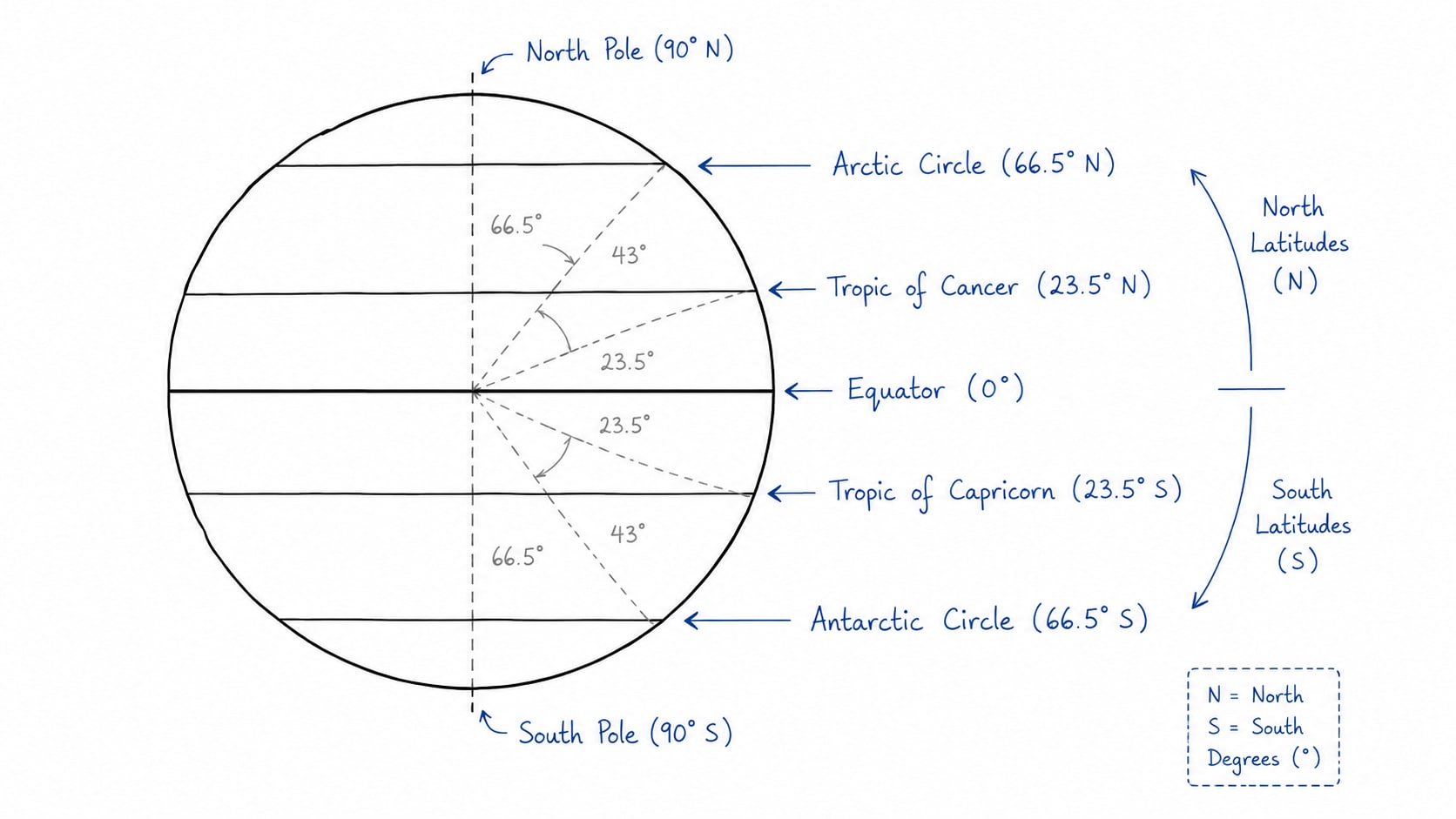
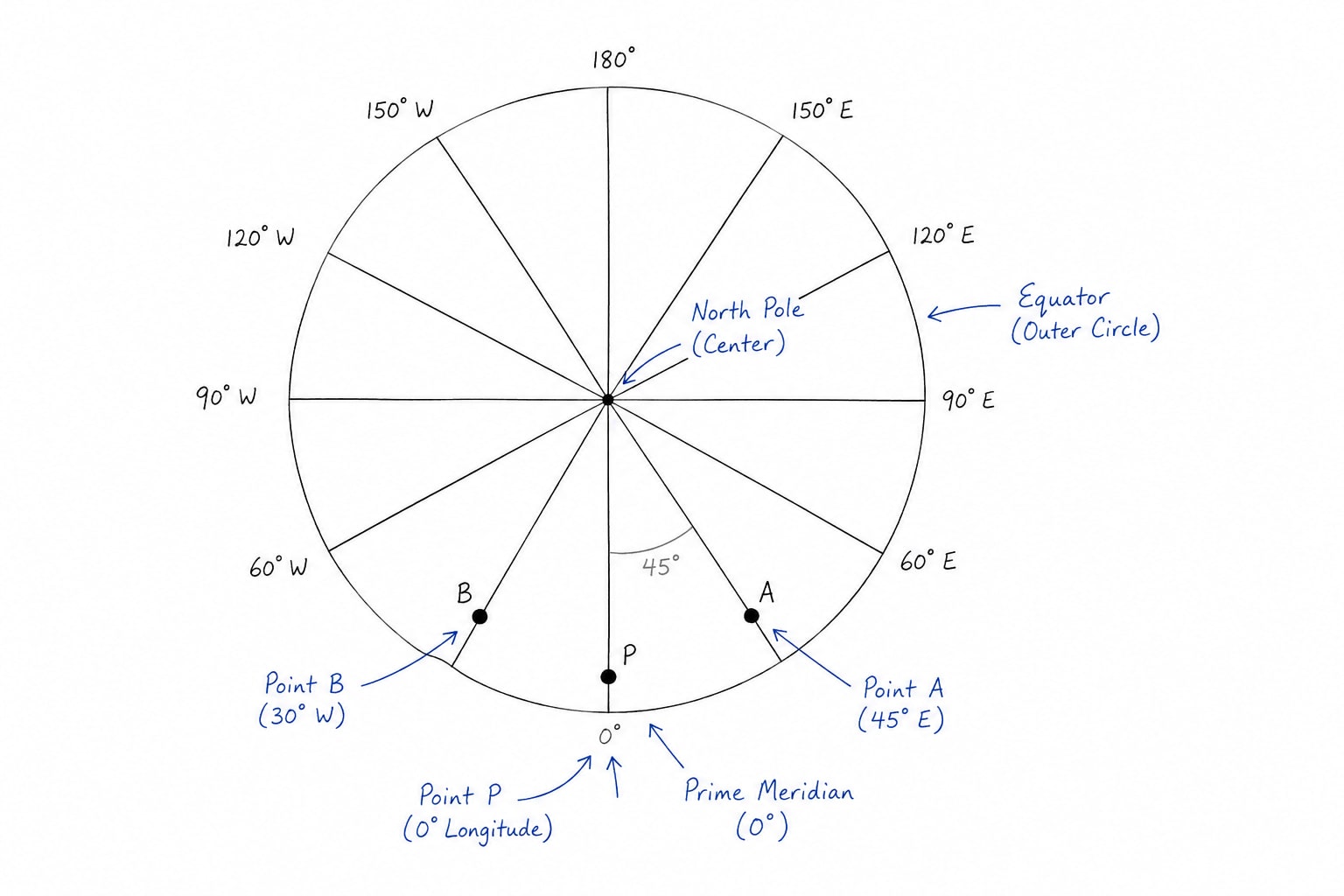
Longitude and Latitude
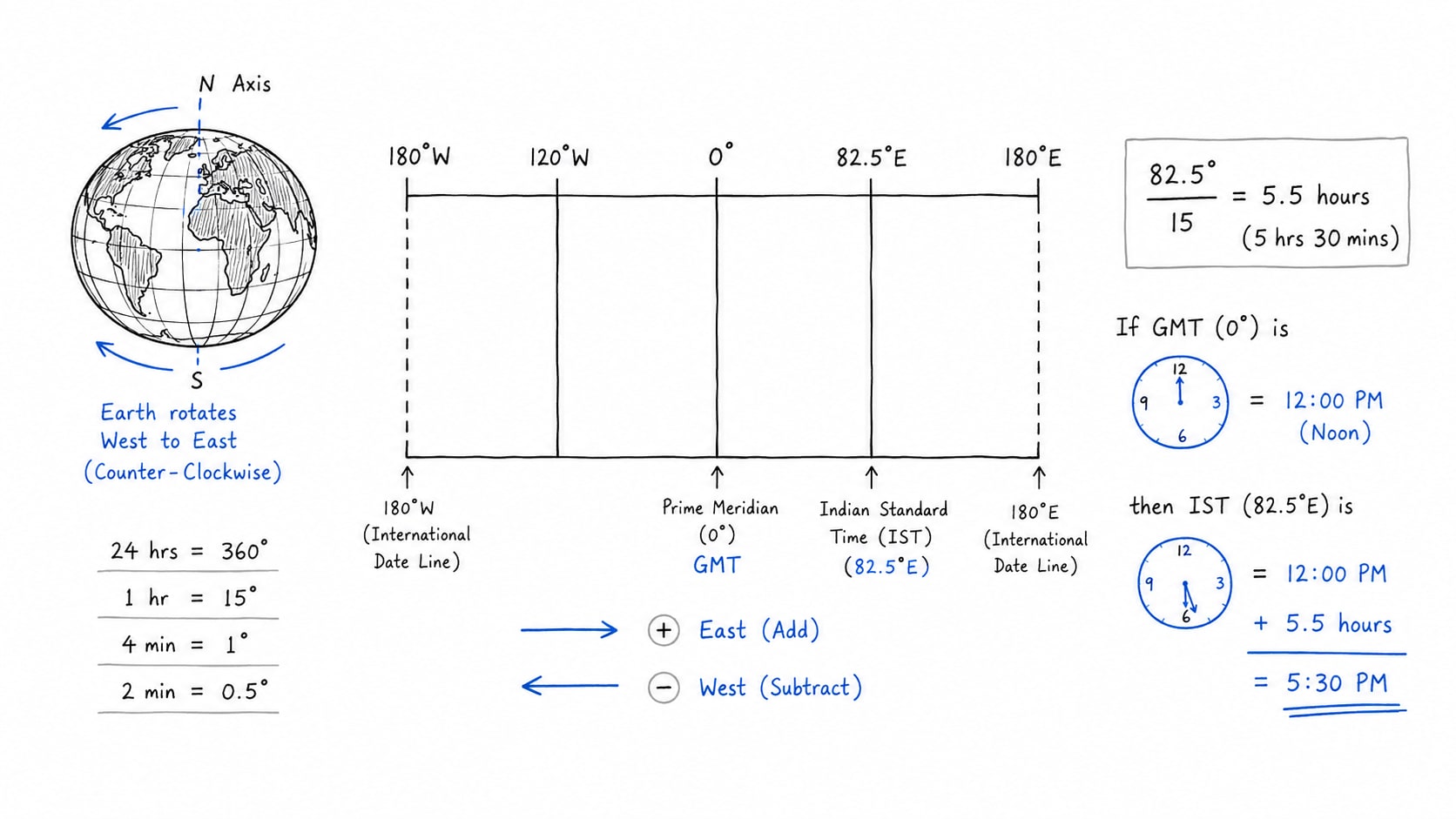
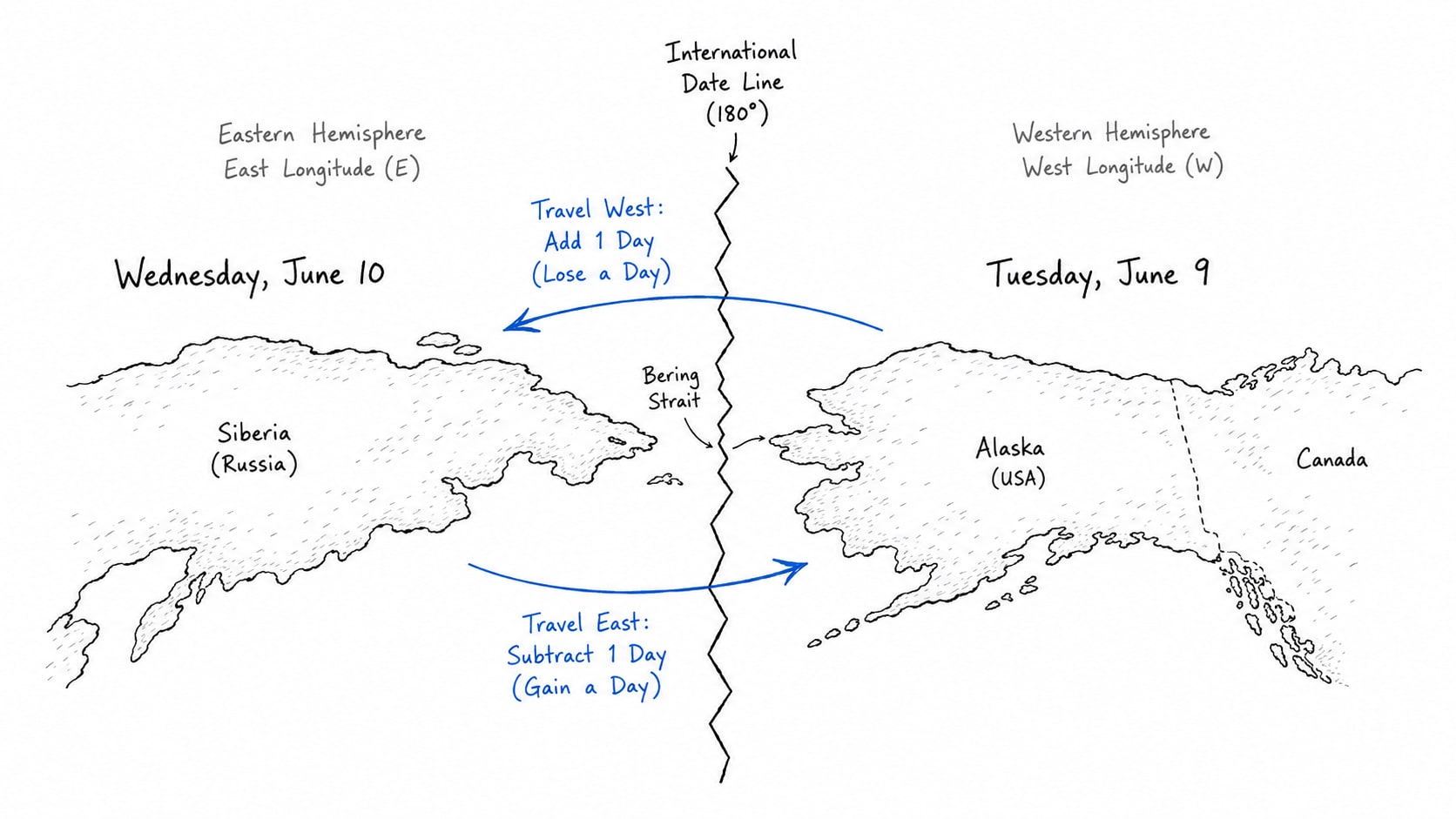
Time Zones
Many countries in the world have more than one time zone because of high longitudinal extent or east to west expansion of their geographical area. e.g., Russia has more than 10 time zones, and the the US has more than 5 time zones. However, France has the maximum number of time zones, especially because of its colonial past. India has only one time zone: IST (Indian Standard Time), which is based on the longitude of 82.5° E near Mirzapur/Prayagraj, Uttar Pradesh. This means the entire country, from Gujarat in the west to Arunachal Pradesh in the east, uses the same clock time. However, the longitudinal distance between the westernmost and easternmost parts of India is about 30°. That's why a debate is going on in the country about having two time zones in India.
Why India should have two time zones?
-
Huge difference in sunrise and sunset Dong in Arunachal Pradesh experiences sunrise during summers at 4 AM approximately
Bhuj of Gujarat experiences sunrise around 6 AM during summers
As a result sun rises nearly two hours earlier in eastern India than in western India. Due to this people in Northeast India start their day much earlier besides this offices and school open after sunrise by a large margin which causes loss of or wastage of valuable daylight
-
Energy Savings: Research by India's scientific agencies and studies by the government expert committee suggest that advancing time in the Northeast could save electricity. The National Institute of Advanced Studies (NIAS), Bengaluru, estimated annual savings of around 200 to 270 million units if eastern India adopts a separate time zone. By doing this less artificial light is needed in the evening.
-
Better productivity and health: People naturally function according to daylight this is called circadian rhythm. In the Northeast early sunrise but late office timing create a mismatch. Children often go to school long after sunrise. Workers lose their productivity because of late start in the morning. Thus, aligning clock time with sunlight can improve sleep cycle, work productivity and health outcomes.
-
Many large countries have multiple time zones e.g. Russia, the US, Canada, Australia, etc.
Why India should not have two time zones?
-
Railways and Aviation safety: India operates one of the world's largest railway networks. Historically before independence different cities of India had different time zones like Bombay time, Calcutta time, Madras time, etc. This was creating a lot of confusion. Today over 13 thousand passenger trains run daily and thousands of flights operate annually. Creating two time zones could increase scheduling complexity and risk of error.
-
Administrative complexities: If Assam follows one time and Bihar another it would make it very difficult to operate government offices, banks, courts, national examination, stock markets etc.
-
Economic Integration: India is highly integrated economically. Thus Every business prefers one clock, one market opening time and one office schedule. Multiple time zones may increase coordination costs.
Alternate solution
Instead of changing clock or time zones we can reschedule office time, school time and most things 1 or hour in advance. e.g. nationwide schools can be started at 7 AM instead of 8 and offices and banks could be started at 9 AM instead of 10. e.g. Similar arrangement is done in Chai Bagan which is one hour ahead of IST informally.
In 2014, the government-appointed committee led by scientist Dr. K. Kasturirangan had given its report and concluded that the benefits of second time zone does exist but operational and safety challenges especially for the railways, outweighed the gains. Thus he recommended retaining a single time zone while allowing flexible working hours.