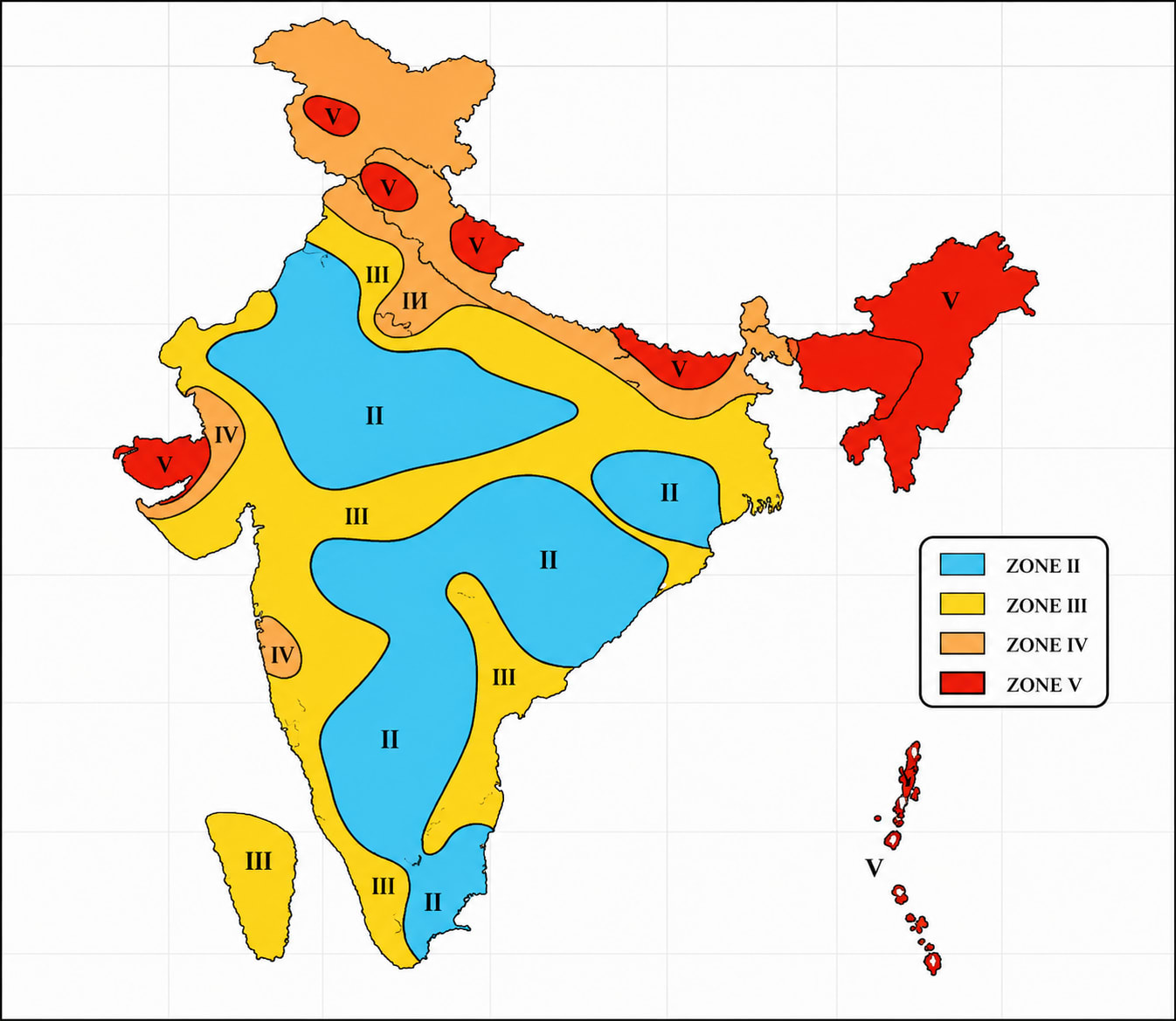

Earthquakes
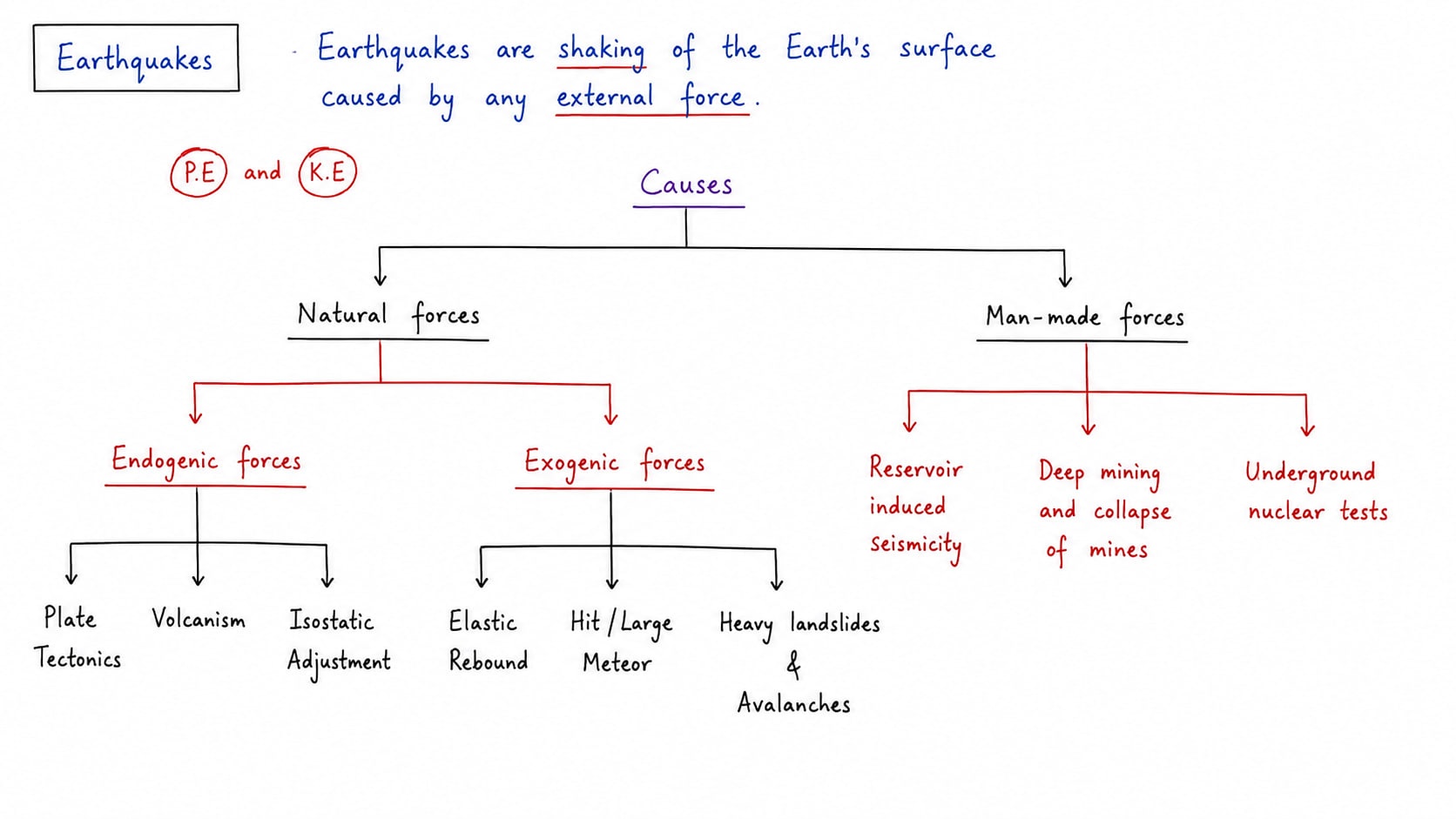
Causes of Earthquakes
- Tectonic Movement:- The Earth's lithosphere is divided into several tectonic plates that are constantly moving due to convection currents within the mantle. These movements occur at convergent (destructive), divergent (constructive), and transform (conservative) plate boundaries. As plates interact, enormous stress accumulates in rocks along faults and plate margins. When this stress exceeds the strength of the rocks, they suddenly break or slip, releasing energy in the form of seismic waves and causing an earthquake. Tectonic movements are responsible for the majority of earthquakes worldwide, particularly around the Pacific Ring of Fire, the Himalayan region, and major fault systems such as the San Andreas Fault.
- Volcanism:- Volcanic activity can generate earthquakes due to the movement of magma beneath the Earth's surface. As magma rises through cracks and fissures, it exerts pressure on the surrounding rocks, causing them to fracture and produce seismic tremors. Explosive volcanic eruptions may also trigger earthquakes by the sudden release of gases and magma. These earthquakes are generally localized around volcanic regions and are often known as volcanic earthquakes. They commonly occur near active volcanoeses such as Mount Etna, Mount St. Helens, and Kilauea.
- Isostatic Adjustment:- The earth's crust sometimes rises or sinks to maintain balance after natural changes in the weight on the surface e.g. when glaciers melt after an ice age, the enormous pressure on the crust decreases. The crust slowly rises upward, causing a stress within the rock. This process is called isostatic adjustment. The release of this stress may produce earthquakes e.g. Greenland is experiencing earthquake very frequently due to melting of the glaciers which is caused by global warming.
- Elastic Rebound:- Earth crust stores a huge amount of energy. The sudden release of stored energy causes earthquakes. Actually earth crust is made of several layers and this is part of the plate. Tectonic forces continuously exert stress on rocks along fault lines, destructive plate, constructive plate and conservative plate margin. These rocks deform elastically and store strain energy over time. When the accumulated stress exceeds the strength of the rock, they suddenly fracture or slip along the fault. The stored energy is then released in the form of seismic waves, causing an earthquake. After the rupture the rock rebounds to less deformed state. Actually this is the factor responsible for most of the earthquakes which occur along fault lines worldwide.
- Heavy landslide or Avalanche:- Large landslides or avalanches also trigger earthquake when a huge mass of rock or ice suddenly moves down mountain slope due to gravity they create deep shaking in the earth surface. It is very important cause of earthquake in hilly areas specially. e.g. Uttarkashi, Chamoli, Pithoragarh district of Uttarakhand.
- Meteoritic Hit:- Sometimes meteors of extraordinarily large size hit earth surface e.g. a meteor hit earth near Mexico about 65 million years ago, they caused a supermassive earthquake, supermassive tsunami led to the extinction of dinosaurs.
- Mining Activities:- Mining operations involves drilling, blasting and removing large quantities of rocks and minerals beneath earth surface. These activities weaken underground rock structure and disturb natural balance of pressure within the crust. Sudden collapses or explosions inside mines can produce deep shaking and small earthquakes. Many mining regions in India like Bastar plateau, Chhota Nagpur plateau, Karnataka plateau keep on experiencing minor earthquakes.
- Reservoir Induced Seismicity:- The construction of huge dams creates artificial reservoir containing massive amount of water. The weight of this stored water exerts pressure on the earth crust below. Water can also seep into cracks in rocks, reducing friction and increasing the possibility of movement along faults. This phenomenon is called reservoir-induced seismicity. Several earthquakes around the world have been associated with large dam projects. e.g. Koyna dam in Maharashtra. (Koyna is tributary of Krishna)
- Nuclear explosion:- Underground nuclear tests release enormous amount of energy in a very short time, this energy creates minor earthquakes.
Types of Earthquake Waves
Seismic waves are the waves of energy produced during an earthquake. These waves travel through the earth and along its surface causing the shaking felt during earthquakes. Scientist study seismic waves to understand the structure of the Earth and to measure the strength and location of earthquakes. Seismic waves are mainly divided into two broad categories
- Body Waves:- They originate from the focus and move through the inner layers of the Earth. They are faster than surface waves. These are of two types
- Primary Waves:- P waves are called primary waves because they travel the fastest and arrive first at a seismic station after an earthquake occurs. It has following properties.
- It carries maximum energy.
- It has shortest wavelength.
- It has maximum speed.
- They travel through solid, liquid and gaseous medium.
- It is longitudinal wave because it causes particles of the medium to vibrate parallel to direction of propagation.
- S Wave:- S waves are called secondary waves because they arrive after p waves.
- These waves move in side to side or up or down motion i.e. perpendicular to the direction of propagation.
- Its wavelength is longer and velocity is slower than p wave.
- It can only travel through solid medium.
- It produces stronger shaking than the p wave.
- It is a transverse wave.
- Primary Waves:- P waves are called primary waves because they travel the fastest and arrive first at a seismic station after an earthquake occurs. It has following properties.
- Surface Wave:- Surface wave originates from epicentre. Epicentre is a point on the surface which is nearest to focus. Types of surface wave
- Love Wave:- Love waves moves the ground horizontally from side to side. They do not create vertical movement. They travel faster than Rayleigh waves. It is named after British Mathematician AEH Love. It is also a transverse wave.
- Rayleigh Wave:- Rayleigh waves move like a wave originating in water if a pebble is thrown into it that's why these have rolling and circular motion. These have slowest speed and responsible for most severe damage.
Measurement of Seismic Waves
Mercalli Scale
The Mercalli intensity scale measures the intensity and effects of an earthquake on people, buildings, and the Earth's surface. It was developed by Giuseppe Mercalli. This scale uses Roman numerals from I to XII.
Properties of Mercalli Scale
- It measures earthquake intensity and damage.
- It is based on observation and effects.
- It uses Roman numerals from I to XII
- It varies from place to place for the same earthquake, depending on population density and efficiency of disaster management.
- Useful for understanding earthquake impact on society.
- The meaning of I on this scale is not felt except by instruments, where XII means extreme destruction.
Richter Scale
Richter scale was developed in 1935 by C. F. Richter. He was from California, USA. It measures the magnitude or energy released by an earthquake. The scale is logarithmic, meaning each whole number increase represents a 10 fold increase in amplitude and about 31.5 times more energy released.
Properties of Richter Scale
- The Richter scale is based on amplitude of seismic waves recorded by a seismograph.
- It is widely used for measuring small and medium earthquake.
- It is logarithmic in nature. With every increase in number it causes much stronger difference between the 2 numbers is 31.5 times in terms of energy and 10-fold increase in amplitude. Meaning of 1 on Richter scale is the energy equivalent to the energy released by explosion of 1 kg of TNT (Trinitrotoluene) a kind of explosive. The difference between 1 and 2 is 31.5 times, difference between 1 and 3 is 31.52 and 1 and 10 is 31.59 times.
- This scale ranges from 1 to 10 but its upper limit is not fixed it could be extended.
- Any earthquake occurring less than 3.5 on Richter scale is usually not felt by humans but felt by animals (specially reptiles).
- Any earthquake occurring 5.5. to 6 on Richter scale is less damaging.
- Earthquake occurring 6.1 onwards can be destructive. 8.0 and above are severely destructive.
- Richter scale is most frequently and widely used scale because of its scientific conclusion and high objectivity.
Moment Magnitude Scale
The moment magnitude scale is the modern scientific scale used to measure earthquake accurately if comes on super high magnitude. It was developed to overcome limitations of the Richter scale, especially for very large earthquake. This scale measured the total energy released by an earthquake based on fault moment, rock strength and the area affected.
Properties of Moment Magnitude Scale
- It measure total energy released.
- More accurate for large earthquakes, use worldwide by modern scientists.
- It is based on seismic moment calculation.
- Does not saturate for powerful earthquakes.
- Provide consistent global comparisons.
Instrument used to measure Seismic Waves
Seismograph
A seismograph is an instrument that detects and records seismic waves during an earthquake. It consist of the recording device.
Seismometer
A seismometer is a sensitive scientific instrument to measure ground motion accurately.
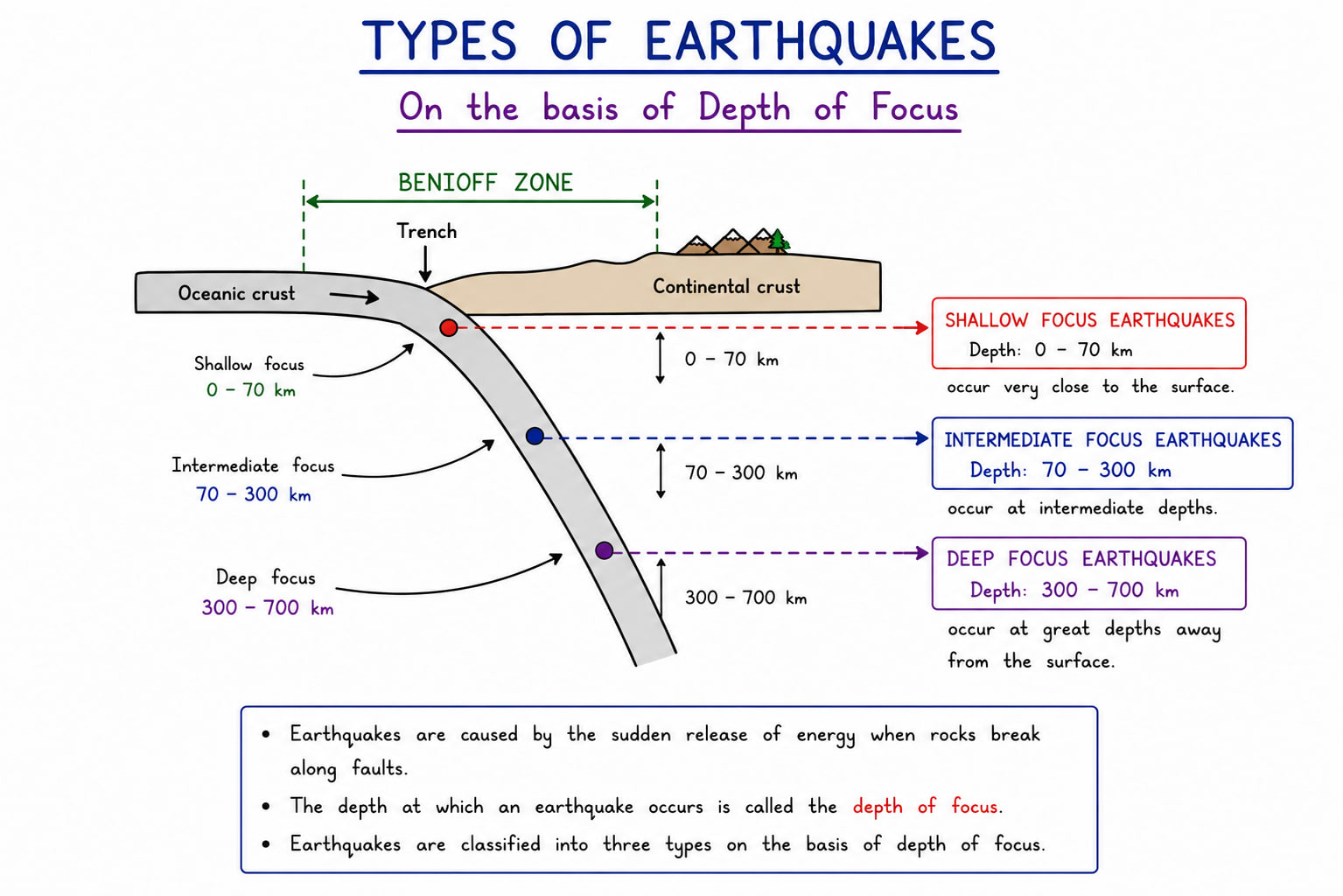
Types of earthquake on the basis of depth of focus
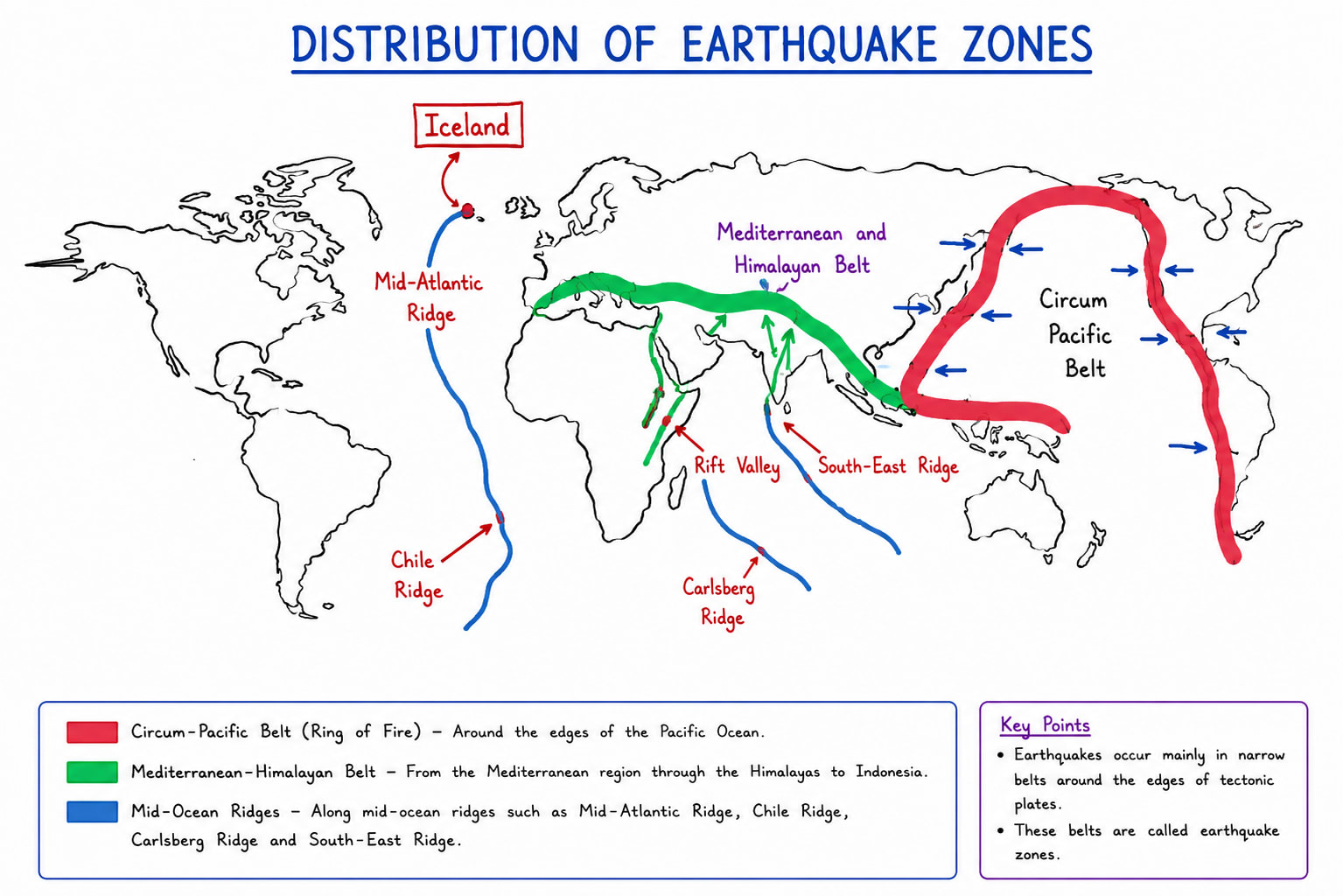
Distribution of Earthquake
Circum Pacific Belt
Circum Pacific Belt which is also called Pacific ring of fire is the largest and most active earthquake zone in the world. It surrounds the Pacific ocean and contains about 75% of the worlds active volcanoes and nearly 80% of major earthquakes. This belt passes through the western coast of North and South America, eastern coast of Asia and Oceania. Countries such as Japan, Indonesia, Chile, US, Ecuador experience frequent earthquakes.
Mediterranean-Himalayan Belt
This earthquake belt extends from the Mediterranean region through Middle East and Himalayan region into Southeast Asia. It is second largest seismic belt in the world. Earthquake in this region occur mainly because of the African plate and the Indian plate collide with Eurasian plate.
Mid-Oceanic Ridge Belt
It lies underwater in Atlantic ocean and Indian ocean mainly. Mid-Oceanic ridges are found along with divergent plate boundaries. Earthquakes in this belt are usually less destructive.