An ecosystem is a functional unit of nature in which living organisms, biotic components interact with one another and with the non-living environment, abiotic components through the flow of energy and cycling of nutrients.
The idea of ecosystem, as definition was given by British ecologist Arthur G Tansley in 1935.
However, the concept of ecology i.e. study of ecosystem(interaction between living and non-living) was Ernst Haeckel in 1866.
Environment
Environment is sum total of everything which is around us in nature like temperature, humidity, sunlight, soil, mountains, valleys, forests, agricultural lands, etc.
The Relationship Between Human Being and Physical Environment
It has been defined as a central theme of geographical thought. Three major approaches emerged to explain this relationship which are known as determinism, possibilism and neo-determinism
Determinism
Natural controlled human activities
Determinism argues that human life, culture, economy and societal development are largely determined by the physical environment. According to this approach factors such as climate, relief, soil, vegetation and location strongly influence human behaviour and development. The founder and supporters of this perspective were Aristotle, Ptolemy, Strabo, Ratzel, EC Semple, Huntington etc. Famous biologist Charles Darwin also believed in the same idea.
Possibilism
Nature provide opportunities, human choose.
Possibilism emerged as a partly reaction against the environmental determinism. It said that the environment sets certain limits and opportunities, but human use culture, technology and knowledge to modify and utilize the environment. Its founder was Vidal-de-la-Blache, a French scholar. Good example to support this argument we have use of technology, aeroplanes, reclamation of land from the sea by Netherland, success of green revolution by using groundwater or irrigation water, etc.
Neo-determinism
Stop and go determinism.
It was given by Griffith Taylor, Australian geographer. His argument was that nature does not completely determine human activities, nor can humans freely do anything they want. Rather nature sets the broad limit within which human development can take place. Taylor compare nature to a traffic. Humans may be able to cultivate semi-arid region using irrigation but excessive exploitation of groundwater shall create problem. Thus the humans should accept the dictate of nature.
Gradually the same idea evolved into the idea of sustainable development.
Levels of Ecosystem
Level of Organization
Definition
Example
Organisms
An individual living being
A single African elephant.
Population
A group of individuals of the same species living in a particular area
A herd of African elephants in a savanna
Community
All the populations of different species living and interacting in a particular area
African elephants, zebras, lions, and acacia trees living in a savanna
Ecosystem
A community of living organisms and their physical environment interacting as a system
A savanna ecosystem including animals, plants, soil, and climate
Biome
A large geographical area with similar climate, flora, and fauna
A savanna biome characterised by grassland and scattered trees, found in regions like Africa and Australia
Biosphere
The global sum of all ecosystems, including all living beings and their relationships
Earth, encompassing all the biomes and living organisms
Habitat and Niche
Habitat is a small or large geographical area in which multiple species lived together and share the resources, food and energy. Habitat is actually address of an organisms it belongs to e.g. camels are found in desert habitat, frog is found in freshwater habitat, penguin is found in polar and sub-polar habitat.
Niche reference to the functional role and position of an organism in an ecosystem, including how it obtains food, uses resources and interacts with other organisms and environment. It is actually role of the species/organisms it plays in the habitat. Niche is never shared by species means every species has its unique niche e.g.
honeybee is a nectar collector and pollinator,
earthworm is a decomposer,
detritivore improve soil structure and nutrient cycle,
tiger regulates herbivore population,
vulture scavenger that removes annual carcasses,
Major Threats to Habitat and Niche
Habitat destruction
It is caused by deforestation, mining, infrastructure projects, agricultural expansion, etc.
Habitat fragmentation
Large habitats are divided into smaller isolated patches by road, railways, dams and settlements.
It affects geneflow, causes human and wildlife conflict e.g. man and elephant conflict in Assam and Kerala, man and tiger conflict in Uttarakhand, etc.
Pollution
Pollution is also a major cause of destruction of habitat.
Pollution includes air, water, soil, plastic pollution, etc.
Invasive alien species
Introduction of exotic species. e.g. Water hyacinth
Overexploitation of habitat resources
Types of Interaction
Type of interaction
Definition
Example
Predation
One species hunts (predator), kills, and consumes another species (prey).
Line preying on a zebra
Herbivory
Another organism (herbivore) eats parts of plants or algae.
Cow grazing on grass
Parasitism
One species (parasite) lives on or in another species (host), deriving nutrients at the host's expense.
Tapeworm in the intestine of mammals
Mutualism
Both species benefit from the interaction.
Bees pollinating flowers
Commensalism
One species benefits from the interaction while the other is neither helped nor harmed.
Barnacles attaching to a whale
Amensalism
One species is harmed while the other species is unaffected.
Black walnut tree releasing juglone, which inhibits the growth of nearby plants
Competition
Two or more species compete for the same limited resources.
Oak and maple tree competing for sunlight in a forest
Facilitation
One species has a positive effect on the survival and reproduction of another species without direct contact.
Alder trees enriching the soil with nitrogen, benefiting other plants
Functions of Ecosystem
Food chain and food web
Transfer of energy
Ecological pyramids
Ecological succession
Bio-geo-chemical Cycle
Food Chain and Food Web
Food chain is a simple sequence of the food relationship between the organisms starting from the producer to top consumer. Food chain start from the autotrophs.
Autotrophs are those organisms which make their food by their own like grasses, phytoplankton, diatom, etc.
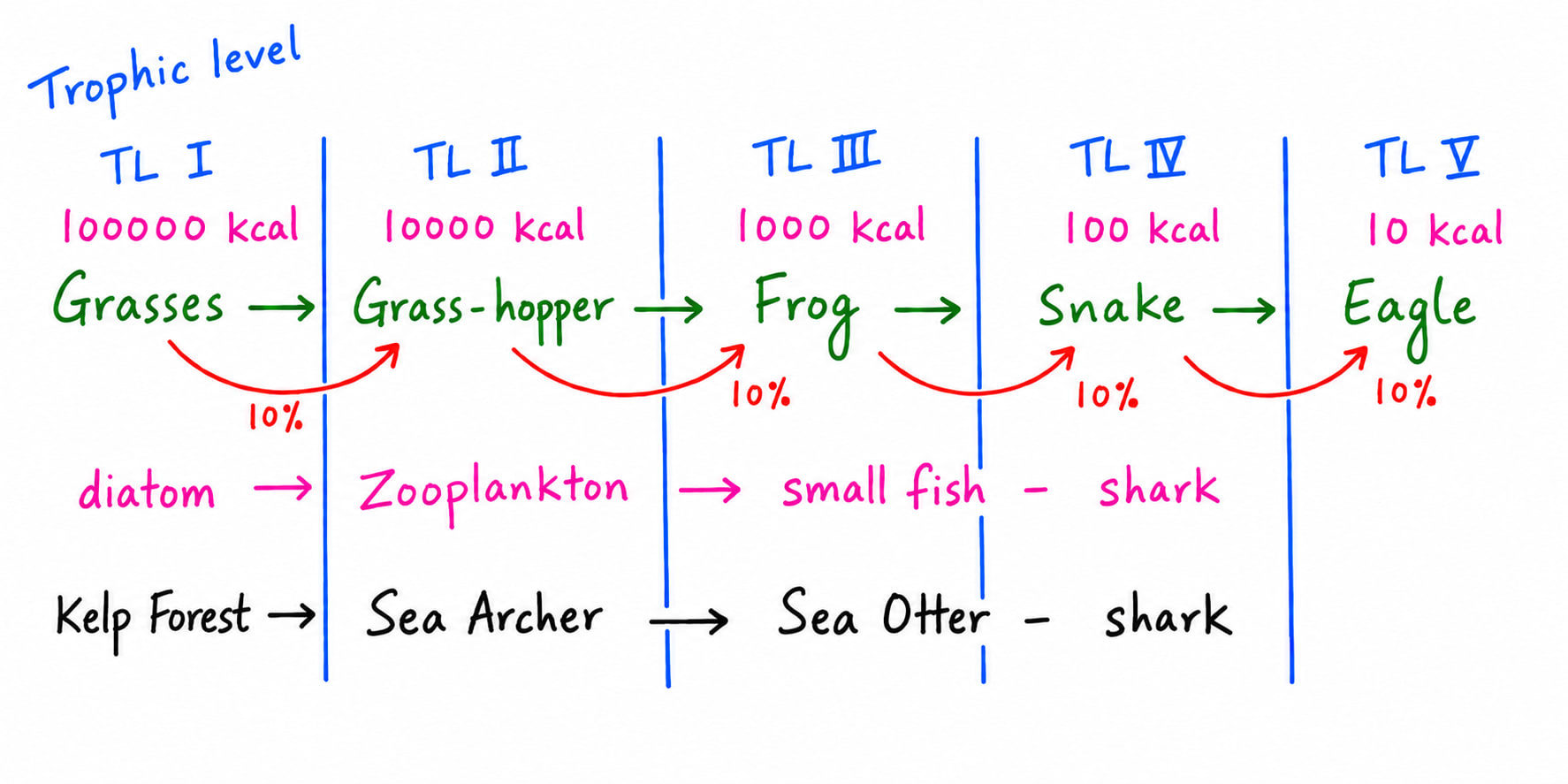
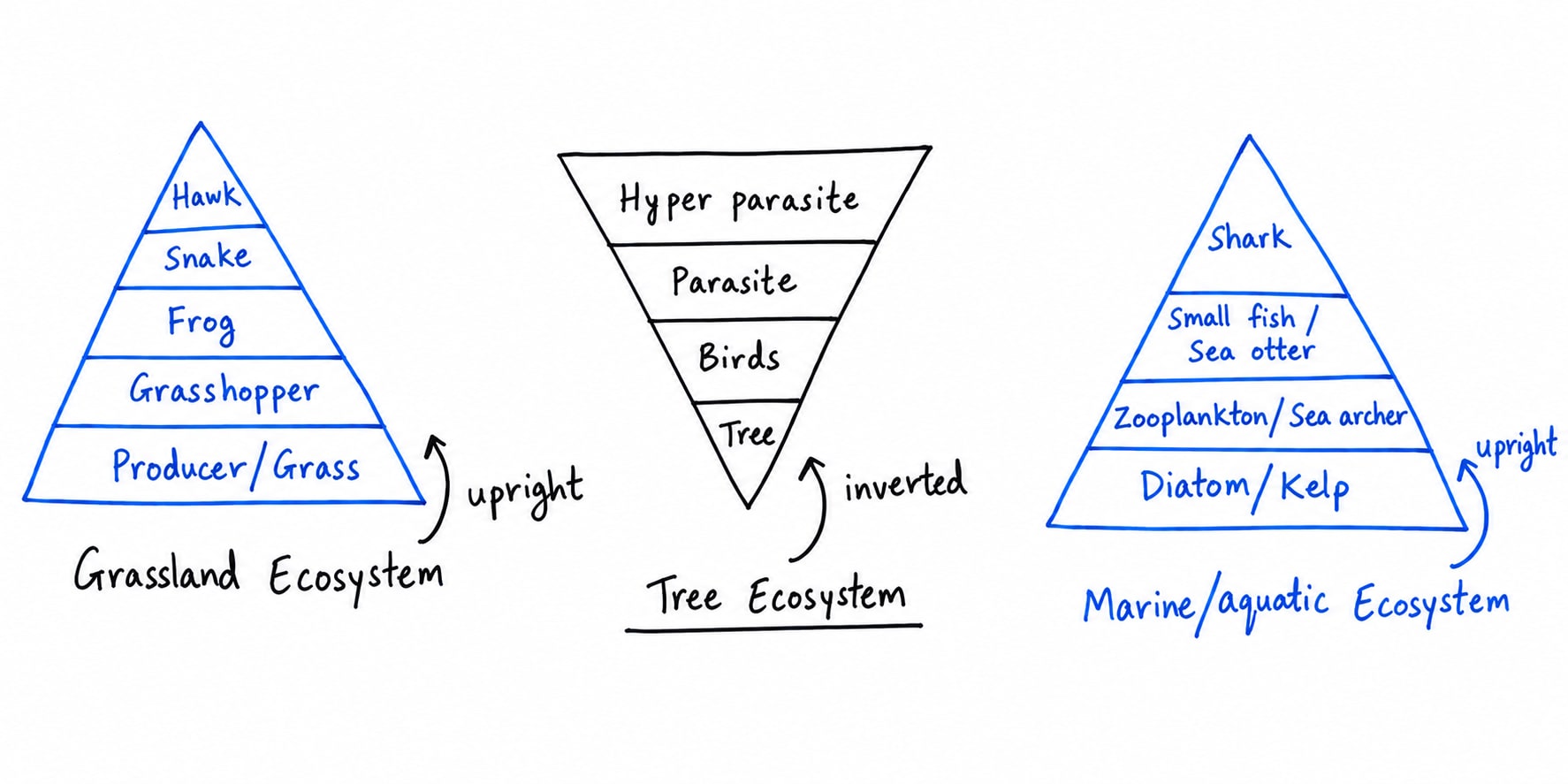
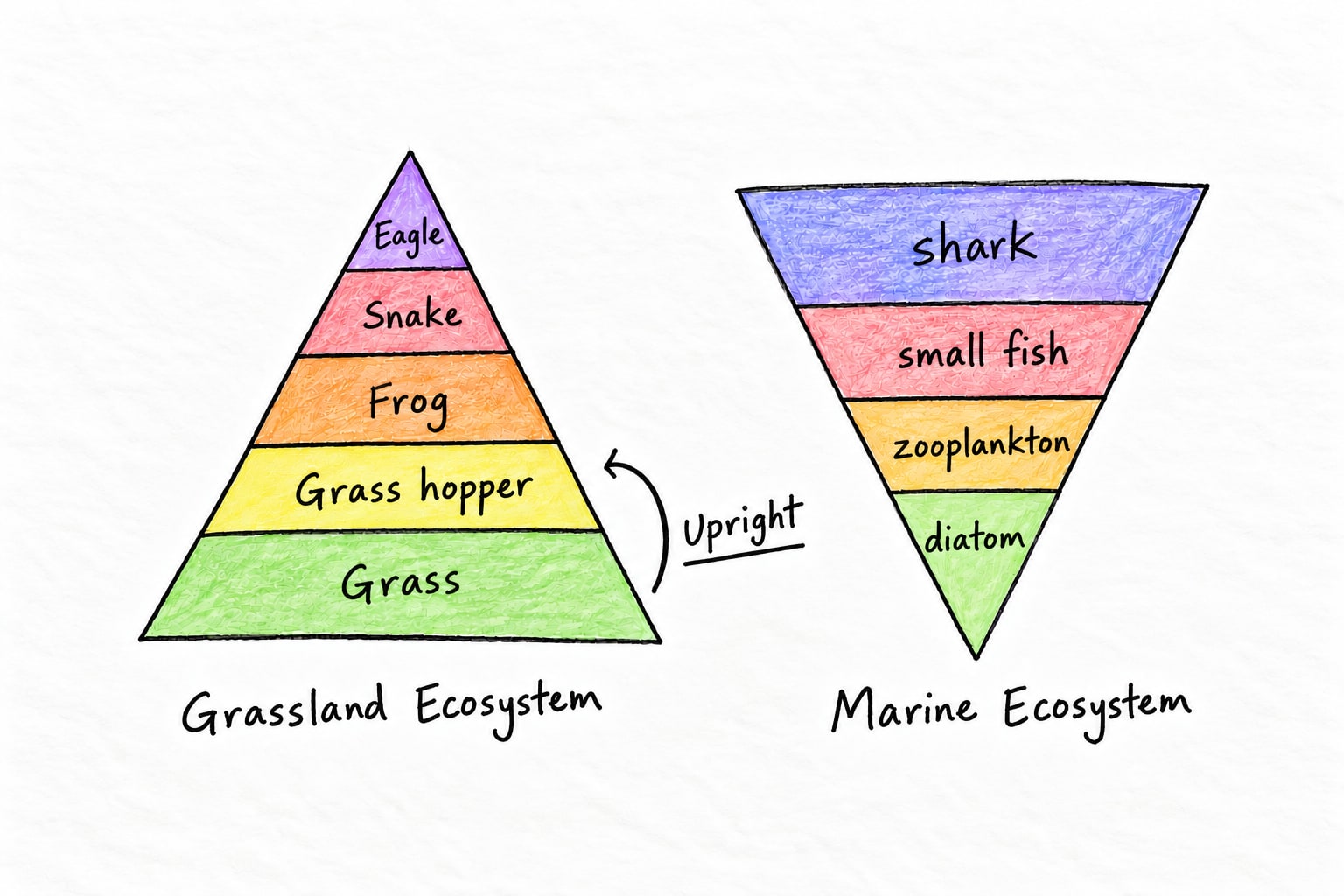
Primary consumers are those organism which depends upon producers these are called herbivores like grasshopper, rabbit, dear, etc. in grassland ecosystem, sea urchins feed upon kelp forests and diatom supports zooplanktons.
Food web develops when the size of habitat become significantly large and huge community develops in the given habitat. In this multiple competitors are found at each trophic level.
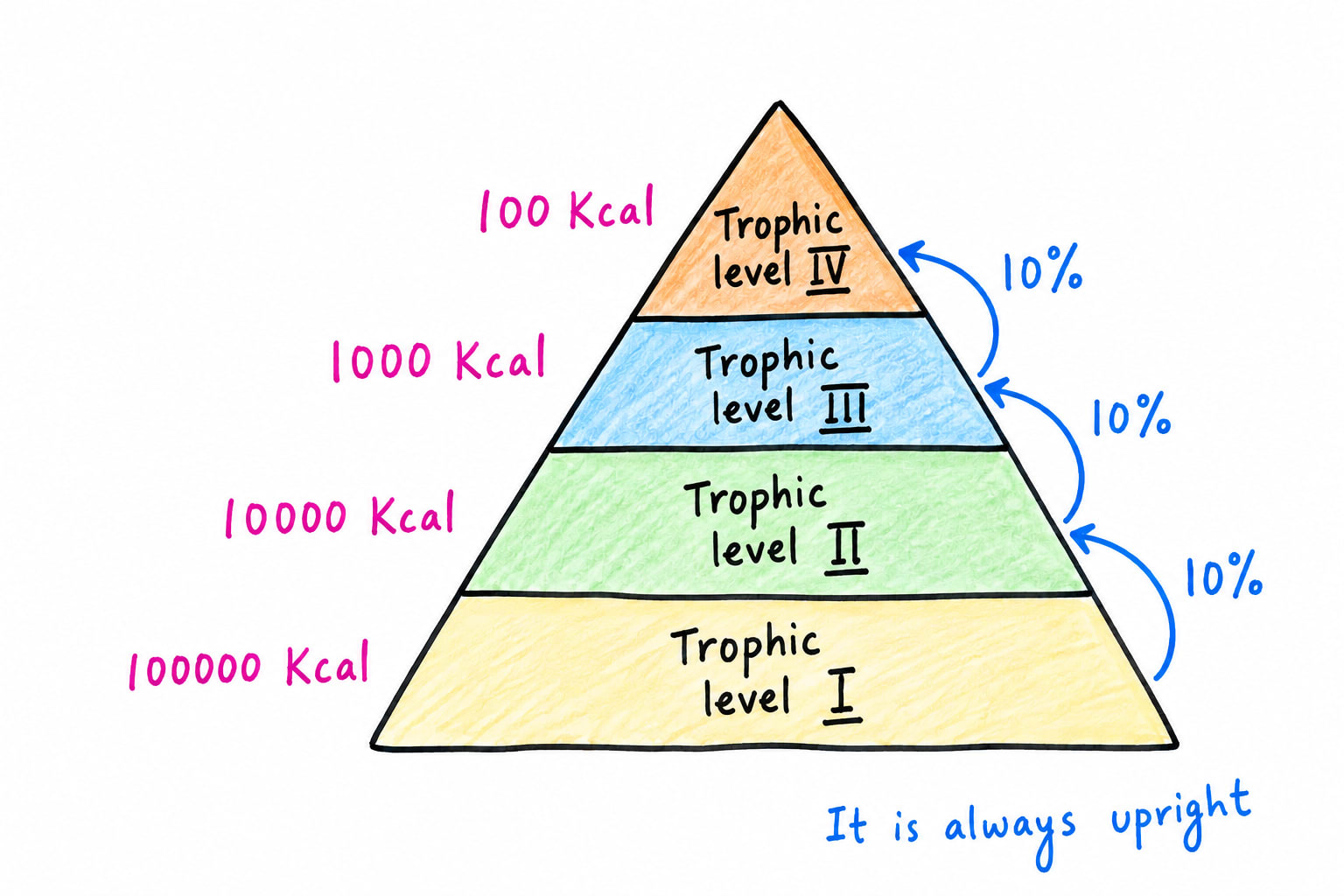
Trophic level is the feeding position occupied by an organism in a food chain or food web based on how it obtains energy. This first trophic level belong to producer, second trophic level belongs to herbivores or primary consumer, third trophic level belongs to secondary consumer or carnivore, fourth or fifth belongs to top predators. A trophic levels do not go beyond fourth and fifth level because each increasing trophic level amount of energy decreases.
Bioaccumulation and Biomagnification
Bioaccumulation is a natural process in which toxic elements or compounds which are not easily soluble into water and soluble only in fat gradually accumulates within an individual organism over its lifetime. Example: fish continuously absorb methyl mercury from contaminated water and food, causing mercury concentration in their bodies to increase. Concentration of cadmium, TDT (Toxic-Dynamics and Toxicity), etc. In bioaccumulation concentration of pollutants is studied only at one trophic level.
Bioaccumulation is the progressive increase in the concentration of a persistent pollutant at successive trophic levels of a food chain. For example when the concentration of methyl mercury increases at the first trophic level in the species, it magnifies at the second trophic level. When the fish/shark or large fish is consumed by humans, it causes Minamata disease. To overcome this problem the Minamata Convention was held in 2013. Minamata Bay is in Japan, where the first case was seen.
Similarly in 2024, Gangetic dolphins were found to have concentrations of DDT and methyl mercury. India is a major user of pesticides like DDT and HCH. Endosulfan is a similar pesticide; however its use has been banned now. It was used by farmers in Kerala and Karnataka in agriculture.
Energy transfer
It is the most important function of the ecosystem. In this producers are reservoirs of energy, which receive energy from the sun and transform that energy into glucose by using photosynthesis. It is considered trophic level 1. Producers include grasses, diatoms, kelp forests, etc.
At trophic level 2, primary consumers are present, which feed upon producers. From the producer to the primary consumer, only 10% of energy is transferred. Similarly from trophic level 2 to 3, 10% is transferred and from 3 to 4 again 10% only. Thus 90% of energy is lost at each trophic level by the species/organism in the process of metabolism and respiration and only 10% energy is transferred. It suggests that with every increasing trophic level, energy decreases.
Ecological Parameters
Number Pyramid
Biomass Pyramid
Energy Pyramid
Ecological Succession
Ecological succession is a gradual, orderly, and predictable process of change in the species composition and structure of an ecological community over time, ultimately leading towards relatively stable community. In simple terms one community gradually replaces another until a relatively stable ecosystem develops.
Key Characteristics
Directional and generally predictable
Takes place over time
Involves replacement of one community by another
Changes the biotic and abiotic environment.
Types of Ecological Succession
Based on Starting Conditions
Primary Succession
Succession begins on a previously lifeless surface where soil is absent. e.g. bear rock, exposed after glacial retreat, newly formed volcanic rock, newly exposed rock after geological processes.
It is very slow process because soil must develop first.
Secondary Succession
Succession occurs in an area where a pervious community existed but was disturb, while and often some organisms remain. e.g. forest recovering after fire, abundant agricultural field, vegetation recovering after a flood or drought.
It is faster than the primary succession
Based on Habitat
Hydrarch Succession/ Hydrosere Succession
This succession begin in water body and progressing towards a terrestrial community. e.g. starting from a pond -> marsh -> meadow -> shrubland -> forest.
Xerarch Succession/ Xerosere Succession
Succession began in a dry habitat such as rock or sand
Important terms in Ecological Succession
Term
Definition
Succession
Gradual and orderly replacement of one community by another over time.
Sere
The entire sequence of communities that develop during succession.
Seral Stage
Each intermediate community occurring during succession.
Pioneer Species
First community to colonise a bare rock after nudation stage.
Climax Species
Relatively stable mature community at a later stage of succession. e.g. Coniferous forest in Taiga, mosses and lichens in tundra, grasses in savanna, cacti dates in desert, etc.
Nudation Stage
Formation of bare area from where succession can start.
Migration
Arrival and dispersal of organisms into newly available area.
Ecesis
It is successful establishment and growth of species in new area
Aggregation
Increase in population of established species through reproduction and colonization.
Stabilization
Development of relatively stable and mature community.
Competition
Species compete for light, water, space and nutrients.
Bio-geo-chemical Cycle
Sulfur Cycle
Sulfur cycle is the circulation of Sulfur between the atmosphere, lithosphere, hydrosphere, biosphere through geological, chemical and biological process. Major reservoirs of Sulfur are
Rocks and Minerals
Oceans
Soil and Sediments
Atmosphere
Volcanic eruptions and fossil fuel burning. Presently thermal powerplants are largest source Sulfur in the atmosphere
Phosphorus Cycle
It is an important sedimentary cycle. It has no significant cases phase under natural conditions unlike carbon, nitrogen cycle. It moves from rock to soil to water bodies to plant to herbivores, carnivores and finally become the part of soil.
Types of Ecosystem
Terrestrial Ecosystem/Biome (It develops on continents)
A biome is a large ecological region characterized by a particular climate, natural vegetation soil and associated animal life. Climate - specially temperature and precipitation, is the primary factor determining the distribution of biomes. Major terrestrial biomes are:-
Forest Biomes
Forest Biomes are the region where tress are the dominant vegetation, generally receiving enough moisture to support continuous or relatively dense tree cover. Types of forest biomes are:
Tropical Evergreen or Equatorial rainforest
Its maximum expansion is found in Amazon Basin of Brazil where it is called Salvas Forest, Congo Basin of Africa, Indonesia and Malaysia.
Temperature 25-30° C.
Rainfall more than 200cm everyday between 2 to 4 PM.
Soil is poor because it lacks humus as rate of decomposition of organic material is too fast to be consumed by the soil.
It also lacks minerals because of leaching.
Major flora are mahogany, ebony, rosewood, rubber, epiphytes (which grows on branches of tree), orchids.
Major fauna are monkey, jaguar, gorilla, chimpanzee, parrots, snake, insects.
Tropical Deciduous or Monsoon Forest
It is found in India, Myanmar, Thailand, parts of Brazil, Africa and Central America.
Temperature is 20-35°C or even more.
Rainfall is 75-200cm but strongly seasonal.
Major flora are teak, sal, shisham, sandalwood, bamboo.
Major fauna are elephant, tiger, deer, gaur, wild boar, monkey.
Tropical Thorn or Dry Forest
It is found in Rajasthan, Deccan India, Sahel region of Africa, Australia.
Rainfall is less than 25-75cm.
Temperature is more than 30°C.
Major flora are acacia, thorny shrubs, khejri, kikar.
Major fauna are camel, antelope, fox, reptiles, rodents: all these have adaptations to survive in a dry conditions.
Vegetation is adapted to survive to dry conditions and that is xerophytic adaptation.
Temperate Deciduous Forest
It is found in Eastern USA, Eastern Russia, China, Japan, Korea.
Temperature is 5-20°C.
Rainfall is 75-150 cm.
Major vegetation is oak, maple, beech, chestnut.
Major fauna are bear, deer, fox, wolf and squirrels.
Temperate Evergreen Mediterranean Forest
It is found in California, across the Mediterranean Basin, Central Chile, cape region of South Africa, Perth, Sydney, and Adelaide of Australia.
It has a mild winter and mild to hot summers.
Rainfall is 30 to 100 cm but only during winters.
Species are olive, scrubs, citrus fruit which are called sclerophyllous vegetation. These are small, thick-barked, waxy leaves, fire-adapted ecosystem
Taiga Coniferous Forest
It is found in Alaska, Canada, Scandinavia, Russia
Temperature is 5°C or below.
Rainfall is 35 to 75 cm.
Tress are spruce, fir, pine and larch.
Animals are reindeer, caribou, moose, brown bear, wolf, llyns.
It is the world's largest terrestrial biome.
Temperate Coniferous Forest
It is found in the USA, Canada, parts of the Europe, and Russia.
Temperature is cool to mild.
Rainfall is 50-300cm mainly in the form of snowfall.
Trees are pine, fir, Douglas fir, and cedar.
Animals are bear, dear, wolf, squirrels.
This has some of the world's largest trees.
Grassland Biome
Tropical Grassland or Savana Biome
It is found in British Africa (Sudan type), Brazil (Campos), Venezuela (Llanos), Northern Australia, rain shadow area of Western Ghats in India.
Temperature is 20-30°C.
Rainfall is 50-150 cm and strongly seasonal.
Soil is highly fertile.
Grasses are tall 12-15 feet. These are called elephant grass, usually have rough external texture.
Major fauna is giraffe, zebra, lion, cheetah, leopard, elephant.
Grasses are immune to fire.
Temperate Grassland
It is found in North America (Prairies), Ukraine, Kazakhstan, Russia (Steppe), Argentina (Pampas), South Africa (Veld), Australia (Downs), and New Zealand (Canterbury Plains).
Temperature is 5-20°C.
Rainfall 25-75cm.
Grasses are short but soft lush green.
Animals are bison, pronghorn, prairie dog and wolf.
Desert Biome
These are characterized by rainfall less than 25cm per annum.
Hot Sub-tropical Deserts
Like Sahara Desert, Arabian Desert, Thar Desert, Australian dessert.
Temperature is more than 40°C.
Rainfall is less than 25 cm.
Flora is cacti, acacia, thorns, shrubs, succulent species, xerophytes.
Fauna is camel, fox, rodents, reptiles, scorpions, lizards, insects.
Most of the tropical hot deserts are found near the coast between 20-35° North and South latitudes along with western coast of continents because
presence of cold ocean currents which reduces moisture holding capacity of the wind
descending column of Hedley cell
effect of continentality that's why trade wind are unable to carry sufficient amount of moisture to rain over there
Cold Deserts
Like Gobi Desert, Taklamakan Desert, Tarim Basin Desert, Ladakh Desert, etc.
It has mild summers but very cold winters.
Rainfall is less than 25cm.
It has grasses and shrubs.
Animals are wild asses, camels, rodents, reptiles
Polar Deserts
It includes Antarctica and Artic island
Temperature is -10°C.
Vegetation is Mosses, lichens.
Animals are seals, penguins in Antarctica and fox in Arctic.
Tundra Biome
Acratic Tundra
It is found in northern Canada, northern Alaska, Greenland in coastal areas, northern Scandinavia and Siberia.
Temperature is -30°C during the winter season and 0-10°C during summers.
Rainfall is less than 25 cm.
Major flora are mosses, lichens.
Major fauna are reindeer, Arctic fox, polar bear, lemming, musk ox.
Antarctic Tundra
It is found across sub-Antarctic.
Major flora are mosses, lichens and alga.
Major fauna are penguins, seals, sea birds.
Alpine Tundra
It is found above treeline in mountains like Himalaya, Alps, Rockies, Andes, etc.
These have grasses, mosses and lichens.
Major fauna is mountain goat, yak, snow leopard, marmot, etc.
Coral Reef
Coral reefs are calcimorphic structures which are made up of calcium carbonate. These structures are made by coral polyps which are micro-marine organisms. These are basically animals which hold zooxanthellae alga in their tissues i.e. plants. Both live in symbatic relationship alga does photosynthesis and the coral polyps provide minerals. Coral reef is actually is that house/habitat which is formed by coral polyps.
Coral Polyps
Coral polyps is a small soft bodied cylindrical animal with
a central mouth surrounded by tentacles.
a simple gastrovascular cavity.
the ability to secrete calcium carbonate which is used to develop coral reef.
Ideal Conditions for Coral Reefs
Temperature should be 23-29°C, warm tropical and sub-tropical waters. Ideal temperatures supports metabolism, calcification and symbiotic alga.
Salinity should be 32-40 ppm. Corals generally can not tolerate prolonged major freshwater dilution.
Maximum depth should 200m and ideally 25-30m to support photosynthesis.
Water should not be absolutely pure and turbid. Pure water lacks minerals and turbid water
Restricts sunlight
Sediments clog the mouth of corals.
On pH scale the water should be alkaline around 8.1, this is required calcium carbonate formation.
Stable platform like a continental shelf or islands.
Types of Coral Reefs
Fringing Reef
A reef that directly borders the coast and attach to it is called fringing reef. In India, the Andaman and Nicobar and the Gulf of Mannar have a number of fringing reefs. Between fringing reef and coast there is a very small and shallow water channel that is called boat channel.
Barrier Reef
A reef parallel to the coast but separated from it by a broad relatively deep lagoon e.g. great barrier reef of Australia i.e. largest barrier reef in the world.
Atoll Reef
It is like a broken ring around submerged island. Lakshadweep, Maldives, Zangibar Island of Tanzania are good examples.
Darwin has given best explanation by saying that fringing, barrier and atoll reefs are sequential development due to subsidence in the platform fringing reef develops.
Distribution of Coral Reef in the World
Largest concentration of coral reef is found in western Pacific near Australia and south-east Asia.
In Indian Ocean, it is found in
Arabian Sea - Gulf of Kutch and Lakshadweep
Red Sea
Bay of Bengal
Andaman Sea like Gulf of Mannar of Palk strait and Andaman and Nicobar.
In southern Indian Ocean it is found near Madagascar, Mozambique, Tanzania.
In Atlantic Ocean it is found in Caribbean Sea region
Distribution in India
Gulf of Kutch, Gujrat
Located near Jamnagar-Kutch coast.
It is protected through Marine National Park and Marine Sanctuary, Gulf of Kutch.
Lakshadweep
It is India's classic atoll system
Gulf of Mannar and Palk Strait
It is protect through Gulf of Mannar and Marine Biosphere reserves/ Marine National Park.
Andaman and Nicobar Island
It is India's one of most biodiversity rich region.
Importance of Coral Reefs
Biodiversity Hotspot
Helps in coastal protection from erosion, cyclone, tsunami.
Supports tourism like scuba diving, snorkelling, recreational fishing.
Carbonate production and geomorphology.
Medicinal importance
Ecological indicator of coral health and marine health.
Threats to Coral Reefs
Climate Change
Ocean warming
Ocean acidification
Sea level rise
Extreme weather
Pollution
Sedimentation by rivers
Addition of urban and industrial sewage
Agricultural runoff
Plastic and solid waste
Oil spills
Unsustainable fishing
Illegal mining
Biological threats like coral disease and invasive species.
Restoration of Corals
Bio-rock technique
A steel structure is placed under water and a low voltage electric current is passed through it. Electrolysis causes minerals specially calcium carbonate to precipitate on the structure and then coral fragments are attached to it.
This technique is used by ZSI to regrow corals in Gulf of Kutch, Gulf of Mannar and Andaman and Nicobar.
Coral Gardening
Coral fragments are collected from healthy colonies and grown in underwater nurseries later transplanted to degraded reefs.
Coral transplantation
Healthy coral fragments are directly attached to degraded reef, substrate using cement, etc.
Larval Prorogation
Eggs and sperm released during spawning are collected, larva are reared and allow to settle on suitable substrate and thereafter out planted.
Government Initiatives
Protection through marine protected areas like Gulf of Mannar Marine National Park, Gulf of Kutch Marine National Park, protected area around Andaman and Nicobar and Lakshadweep.
Wildlife Protection Act 1972
Environment Protection Act 1986
Costal Regulation Zone Framework 2019
National Coral Reef Research Centre at Port Blair.
Climate adaptation in Island ecosystem.
Lake Ecosystem
A lake is lentic, non-flowing aquatic ecosystem in which abiotic factors interact with producers, consumers and decomposers. The ecological condition of a lake is understood by reading its trophic state that is the level of nutrient enrichment and biological productivity. CPCB broadly classify lakes
Oligotrophic lake
Young/low nutrient stage
Very low nutrient particularly nitrogen and phosphorous.
Low algal and phytoplankton productivity.
Water is generally clear and transparent.
High dissolved oxygen up to greater depth.
Low biological oxygen demand
Mesotrophic Lake
Intermediate Stage
Moderate nitrogen and phosphorous.
Moderate alga
Water become less transparent.
Oxygen is generally adequate.
Biological oxygen demand is higher than oligotrophic.
Eutrophic Lake
Excessive nitrogen and phosphorous.
Heavy growth of alga.
Water becomes turbid or green.
High concentration of dead organic matter.
Condition of hypoxia or anoxia.
High biological oxygen demand.
Important Lake in News in 2026
Dal Lake, Jammu & Kashmir — Eutrophication
Bellandur Lake, Karnataka — Severe sewage inflow; eutrophication and water-quality degradation. The lake remains under rejuvenation efforts and NGT scrutiny in 2026.
Varthur Lake, Karnataka — Severe sewage pollution; eutrophication and water-quality degradation. Rejuvenation remains incomplete.
Ulsoor Lake, Karnataka — Urban pollution and water-quality concerns
Hussain Sagar Lake, Telangana — Pollution and eutrophication
Sukhna Lake, Chandigarh — Soil erosion and siltation in the surrounding catchment
Loktak Lake, Manipur — Hydrological alteration
Naini Lake, Uttarakhand — Sewage pollution
Vembanad Lake, Kerala — Pollution and ecological degradation
Pulicat Lake, Andhra Pradesh–Tamil Nadu — Nutrient enrichment and ecological stress
Government Initiative
National Plan for conservation of aquatic ecosystem.
Wetland Conservation and Management Rules, 2007
AMRUT 2.0 (Atal Mission for Rejuvenation and Urban Transformation)
It is particularly important for urban lake and water bodies rejuvenation.
Mission Amrit Sarovar
It was launched in 2022.
It focuses on creating, rejuvenation of waterbodies particularly at the rural and local level.
Wetland Rejuvenation Program
It is promoted by Ministry of Environment, Forest and Climate Change.
CPCBs role in Lake protection
Water quality monitoring.
Identification of polluted waterbodies.
Standard for water quality.
Monitoring biological oxygen demand, dissolved oxygen, nutrient, coliforms, etc.
Advising pollution control measures.
Wetland Ecosystem
According to Ramsar Convention, wetland includes marshes, fens, peatlands or areas of water whether natural or artificial, permanent or temporary with fresh brackish or salt water and even marine water up to depth of 6 meters.
Ramsar site, a Ramsar site is a wetland that has been designated as wetland of international importance under the convention on wetlands. A wetland become a Ramsar site when the concern country designated it for inclusion in the Ramsar list because at least satisfy one of the nine criteria. The criteria are:
Criteria 1
The wetland contains a representative, rare or unique example of a natural or near natural wetland type in its biogeographic regions.
Criteria 2
Supports vulnerable endangered or critically endangered species.
Criteria 3
Supports population of plants/animals important for maintaining the diversity of particular biogeographic region.
Criteria 4
Supports species at a critical stage of their lifecycle or provide refuge during adverse conditions.
Criteria 5
Regularly supports 20 thousand or more water birds.
Criteria 6
Regularly supports 1% of the individuals in a population of one species of water bird.
Criteria 7
Supports a significant proportion of indigenous fish species which is important for global biological diversity.
Criteria 8
It is important fish feeding area, spawning ground, nursery or migratory route.
Criteria 9
Regularly supports 1% of the individuals in a population of one species of wetland dependent non-avian animals.
What is Montreux Record?
It is the record of Ramsar sites where adverse changes in ecological character have occurred or occurring or likely to occur due to natural or human interference.
Number of Ramsar sites in India on Montreux Records
Lake Loktak, Manipur since 1993
Keoladeo National Park, Rajasthan since 1990
Number of Ramsar sites in India till 13th 2026 are 101. Recent addition include
Glaw Lake, Arunachal Pradesh (101).
It is India's first Ramsar site in Arunachal Pradesh.
It is a freshwater lake inside Kamlang Tiger Reserve and Wildlife Sanctuary in the Eastern Himalayas.
It is culturally important to the Mishmi community.
It is a Central Asian Flyway stopover for bare-headed geese, painted storks and ducks.
Chhari-Dhand, Gujarat.
It is a seasonal saline wetland in Kutch.
Patna Bird Sanctuary, Uttar Pradesh.
It is in Etah district.
Siliserh, Rajasthan.
It is a human-made lake near Sariska, a tiger habitat, supporting more than 1% of the biogeographic population of black storks.
Importance of Wetlands
If tropical rainforests are called the lungs of the world, then wetlands are often called natural kidneys/sponges and a biological supermarket. These simultaneously perform ecological, hydrological, and economic functions.
Ecological Importance
Nutrient cycling
Wetland acts as a biochemical recycling processing zone
Mica organisms have been transformed nitrogen, phosphorus, sulphur, and carbon. They can retain excess nutrients before these reach the worst lakes and coastal waters.
Carbon sequestration ratio
Peatlands, mangroves, and some freshwater wetlands store a large quantity of carbon. Therefore wetlands contribute to climate change mitigation.
Water purification
Wetlands can trap sediments, excess nutrients, some pollutants, and suspended particles.
Maintain foodweb
High biodiversity hotspot
Hydrological Importance
Flood control
Groundwater recharge
Drought protection
Coastal protection
Economic Importance
Fisheries like fish, prawn, crab, molluscs
Agriculture
irrigation water, groundwater recharge
Livestock
Forestry, like grasses, medicinal plants, fibres
Tourism
Bird watching
Nature photography examples: Chinkara Kala Dev.
Social-livelihood Importance
Food, water, and fisheries contribute to poverty reduction, livelihood security, food security, water security, etc.
Cultural and religious importance
Sacred water bodies like Pushkar, Rasta, Lotak in Manipur, Chhath pooja in Bihar, Harika in Punjab, etc.
Scientific and educational importance
like evolution, hydrology, migration, nutrient cycle, adaptation, etc.
Government initiative to conserve wetlands
Wetland Conservation and Management Rule, 2017
This is the principal regulatory framework for wetlands in India. Key provisions are
Prohibits conversion of wetland for non-wetland use
Restrict activities such as
Encroachment
Setting up/expansion of industries
Solid waste dumping
Discharge of untreated waste
Permanent construction in specified wetland area
Certain activities that alter the ecological character
Provides for states/UTs wetland authorities
Emphasise the wise use of ecological character rather than simply fencing of wetlands.
2017 rules have replaced the rules of 2010
National Plan for Conservation of Aquatic Ecosystem
It is an outcome of the merger of the National Lake Conservation Plan and the National Wetland Conservation Programme.
This merger took place in 2010. Its objectives are integrated conservation and restoration of lakes and wetlands. That is why the name is aquatic.
It works under the Ministry of Environment, Forestry, and Climate Geology.
National Wetland Conservation Programme
It has been the 4th National Plan for Conservation of Aquatic Ecosystem, which we just discussed, but it was launched in 1985-86.
Amrit Dharohar initiative
It was announced in 2023-24. Its objectives are to promote optimal use of Ramsar site while enhancing
Biodiversity
Carbon stock
Livelihood opportunities
Eco-tourism
Local community participation
Its basic philosophy is conservation + livelihood + sustainable use, rather than treating a wetland merely as a protected area.
Mission LiFE
It promotes behaviour changes such as
Reducing plastic waste
Responsible consumption
West segregation
Sustainable tourism
Water conservation
MISHTI
MISHTI stands for Mangrove initiative for shoreline habitat and tangible income.
Although it is primarily a mangrove program, it is relevant to coastal wetlands.
It was launched in 2023 on World Environment Day, 5th June.
It aims to promote
Mangrove restoration
Afforestation
Coastal resilience
Livelihood opportunities
Climate change mitigation
Ramsar Convention
It was signed in 1971 and became effective in 1975.
India became its member and contributing party in 1982.
It is effective in India since 1st February 1982.
India's first two Ramsar sites were Chilka and Keoladeo. Both were designated on 1st October 1981. Before India became a formal contributing party in 1982, these two sides were designated.
Threats to wetland
Biological threats
Wetland aging or lake aging
Climate change.
Frequent drought
Desertification
Man-made threats
Encroachment and change in land use
Pollution
Introduction of alien species
Expansion of agriculture activities
Mangrove Ecosystem
Mangroves are salt-tolerant evergreen trees and shrubs that grow in inter-tidal zone, the area periodically flooded and exposed by tides at the interface of land and sea. They are found mainly along asheries, river delta, tidal creeks, lagoons etc. There are various species of mangroves, like Rhizophora, Abicennia, Sonneratia, etc.
Global distribution
Mangroves are completely distributed between the tropics and subtropics. It includes
south and Southeast Asia
East and West Africa
Northern Australia
Caribbean and Central America
Tropical South America
Distribution in India
India's mangroves are along nine coastal states and four UTs.
West Bengal - Sundarbans
Gujarat - Gulf of Kutch and Gulf of Khambhat
Odisha - Mahanadi Delta and Bhitarkanika
Andhra Pradesh, Krishna Godavari Delta
Tamil Nadu
Kerala
Karnataka
Goa
Maharashtra
UTs are
Andaman and Nicobar
Puducherry
Dadar and Nagar Haveli
Daman and Diu
Area-wise:
West Bengal - 42.5%
Gujarat - 23.32%
Andaman and Nicobar - 15.19%
Andhra Pradesh - 8.44%
Maharashtra - 6.31%
Odisha - 5.19%
Adaptation mechanism
Adaptation to waterlogging near the roots
Stilted root and pneumatophores (breathing roots)
Adaptation to salinity
Extraction of salt from the roots and from the leaves
Vivipary
Germination of embryo in the branches of the tree
Flexible steam and branches to adapt to tidal fluctuations
According to ISFR (Indian Survey of Forest Resource), 2023 India's total mangrove cover is 4991.68 square kilometre. This represent approximately 0.15% of India's geographical area.
Compare to survey report 2021 there was a decline of 7.43 square kilometre.
Importance of Mangroves
Ecological importance like fish, prone, crabs, reptiles, mammals.
Economic importance like aquaculture, eco-tourism, fisheries.
Costal protection form tsunami, cyclone.
Climate change mitigation.
Mangroves are important bule carbon ecosystems. They capture atmospheric carbon dioxide and store carbon in biomass, roots and particularly water logged sediments.