
Governance#
Governance, in simple words, can be defined as a process that leads to policy-making and policy implementation. Governance in general focuses upon the what, how, and why aspects of development and policymaking.
The World Bank defines governance as the manner in which power is exercised in the management of a country's economic and social resources for development.
UNDP defines governance as the exercise of political and administrative authority to manage a country's affairs at all levels. It comprises the mechanism, process, and institution through which citizens articulate their rights, exercise their legal rights, meet their obligations, and mitigate their differences.
Is governance limited to government only?#
Governance is not limited to government. While government includes the legislature, executive, and judiciary, governance includes not only the government but also civil society, NGOs, and private players, media. Focuses purely on citizen-centric administration.
We can say,
- While government is structural, governance is functional.
- While government is rule, governance is goal.
- While government is a decision maker, governance is a process.
- While government is a decision maker, governance is a process.
- While government focuses upon roles, governance focuses upon performance.
- While government focuses upon implementation, harmony, and coordination with efficiency.
- While government focuses upon output, governance focuses upon outcomes.
e.g. Jan-Dhan scheme. The objective of Jan-Dhan scheme was to ensure financial inclusion. However the other objective of Jan-Dhan was also to bring rationalization in welfare schemes and eliminate ghost beneficiaries in meeting social aspirations, which can further bring accountability and transparency into the system, which was accomplished by JAM Trinity, that is, Jan-Dhan, Aadhaar, and mobile. This has paved the way for nationalization, accountability, and transparency.
Good Governance#
Good governance is when governance is carried out with due concern for several elements such as transparency, accountability, responsiveness, etc. and can be termed as good governance. The concept of good governance was popularly given by developed world countries, expecting it to be followed by developing third world and fourth world countries.
Good governance as a concept was established. Its focus would bring out third-world and fourth-world countries (that is, the Global South and LDCs) from absolute poverty and inequality.
The World Bank in 1992 advocated this concept of good governance and this model of good governance was refurbished in the year 1997 by the UN in a UNDP document.
UNDP highlights eight pillars of good governance, which are shown below.
Pillars of Good Governance#
- Accountable
- Transparent
- Equitable and inclusive
- Effective and efficient
- Follow the rule of law
- Participatory
- Consensus-oriented
Participation#
People's participation in government, either directly or indirectly, ensures good governance and this is done through elections, protests, demonstrations, public debates, indirect participation in policymaking through forums like mygov.in
Consensus-oriented#
UNDP advocated that views of all the sections should be taken into account, thereby establishing a common position. This can be done through consultation, post-legislative input, continuous feedback, etc.
Accountability#
Accountability means the responsibility of government, which ensures a mechanism where questions can be asked about the functionality of government. This should be done at both the vertical and horizontal levels, keeping a check on action. This can be done through social audit and their different instruments, like RTI, through which we can achieve this.
Transparent#
It is the process or a provision that makes it possible for the people to know the decision-making of the government. Information should be freely available in an easily understandable format, like a self-declaration or proactive suo moto disclosure.
Responsiveness#
Government should respond to the need within the given time frame. The response should be educated and it should be citizen-friendly and this can be done through the Right to Service Guarantee Act.
Equitable inclusion#
No citizens shall be excluded, even the weakest must be given an opportunity to participate in the process, taking measures to provide equity to individuals. In India the reservation policy is the classic example based upon intelligible differentials and provides equitable and inclusive participation.
Effective and efficient system#
Resources are limited or are not unlimited. Therefore, with the concept of sustainability, efficiency comes and establishes challenges at the same time. From the perspective of governance this should not be counted as a challenge, rather as an opportunity. Therefore we can achieve this efficiency part through evaluation of scheme performance linked incentive, etc.
Rule of law#
For effective and efficient administration, impartial enforcement of law, and protection of human rights, the rule of law is very important. This can be done through an effective judicial system and police reform.
Historical Reference to Good Governance#
Is good governance a model, a concept given by the West, or is it a concept which was very much there in the roots?
Although good governance as a concept was largely popularized by the Western world, there have been numerous references where good governance is seen in history.
Ramayana references#
The concept of Ram Rajya in Indian society can be seen when the happiness of praja and better governance through justice is good governance. The episode of Sabri highlights the concept of an equilateral inclusive society, whereas Agni Pariksha, on the consensus apprehension of people and the obligation of the king, even above the family, is for the people and highlights accountability.
Mahabharata references#
In this period leadership, dutifulness, self-realization, and above all, the establishment of the rule of law i.e., through dharma-yuddha is the classic example of modern-day good governance only.
Kautilya's Arthashastra#
In Kautilya's Arthashastra the welfare of people was considered paramount in the role of the king. In Kautilya's period efficiency through the model of accountability was the epicenter, which is similar to modern-day values of good governance.
Ashoka Period#
In the 2nd and 3rd centuries BCE, Ashoka's edicts can be seen. Emperor Ashoka's inscription on pillars, on rock, across the empire lists policy and edicts promoting transparency in governance. These edicts communicated the emperor's directive and moral guidelines, ensuring that the people were informed about the government's action and intention. This shows transparency.
In the Ashoka Empire responsiveness can also be seen through this, as he appointed dharmamahamatras to look after people's welfare and address their grievances. This shows participation and transparency both.
Gandhi-Modern history#
Gandhi advocated, during the freedom struggle, the concept of swaraj, which means good governance, which is the classic example of our commitment towards modern India and accountability. He advocated for harjan Seva in his attempt to bring about and ensure that society is established to foster commitment and to end the caste divide.
Indian Constitution#
- The Indian Constitution, even today, outlines the commitment to a welfare society and ensuring socio-economic justice.
- The rule of law can be seen and traced in the very founding principles of the Constitution.
- Even the modern goals of the UN and the SDGs, which India has been committed to following, have outlined the commitment of India to establish and pursue their goals with full commitment.
Finally we can say that UNDP consolidated the idea; however these ideas have been very much cherished since ancient times.
Initiatives of good governance#
As a party to International Covenant on Civil and Political Rights (ICCPR), India is under an obligation to effectively guarantee citizens.
- RTI as per Article 19 of ICCPR
- RTI Act, 2005, makes a significant shift in Indian democracy.
- It gives greater access to citizens to information, which in turn improves the responsiveness of government to the community's needs.
- RTI promotes openness, transparency, and accountability in administration by making the government more open to public scrutiny.
- E-governance
- National e-governance plan vision: to make all governance services accessible to the common man in his locality. Through common services delivery outlet to ensure efficiency, accountability, reliability, and such services at an affordable cost
- e-governance effectively delivers better programming and services in the area of newly emerging communication technology, which was held out as a new opportunity for rapid economic transformation worldwide.
- e-governance has direct impact on each citizen who deliver direct transaction who derive direct transaction with services offered by government. Various initiatives have been taken.
- Example: PRAGATI, Digital India Program, online income tax where the focus is on minimum government and maximum governance.
- Legal reforms
- The central government has nearly scrapped 1,500 absolute laws and rules with the aim of bringing transparency.
- India has reformed the criminal justice system, where the new laws Bharatiya Nyaya Samiksha (BNS) and Bharatiya Nagarik Suraksha Samiksha (BNSS) have been made.
- Policy Reforms
- In police various steps have been taken in the existing framework and the government has formed and provided, in laws, various frameworks to bring accountability.
- For example, new provision of FIR
- Under BNSS, provisions for registering an FIR irrespective of jurisdiction have been outlined. The officer in charge can't refuse to register an FIR on the basis of lack of jurisdiction. He is legally bound to register an FIR.
- Rules for videography, which are as follows:
- BNSS mandates videography during the search conducted by police. A cloud-based mobile application e-Sakshya has been designed by the National Information Centre for law enforcement agencies, which allows multiple photos and videos as e-Sakshya in an initiative under ICJS (Interoperable Criminal Justice System). This data will be available to other agencies such as the judiciary, prosecution wing, and forensics.
- Provisions of arrest
- Information about the arrested person must be mandatorily displayed at the police station. Section 37 under the NSS requires a police officer in every police station, not below the rank of ASI, to be responsible for maintaining and prominently displaying the information about the arrested person.
- Boards, including the digital board, must contain the name, address, and nature of offense. Must be input outside the police station and district control room
- Provision of an officer not below the rank of DySP is mandatory for arresting a person charged with an offense where the punishment is less than 3 years if the person is in the age of 16.
- Rules related to timeline
- In case of medical examination of a victim of rape, the registered medical practitioner needs to forward the medical report to the investigation officer within 7 days.
- Investigation of POSCO cases is required to be completed in 2 months of recording the information of an open case is with rape cases.
- It is to be noted that in the case of zero FIR once the case has been registered, the transfer of the case to the appropriate police station must happen.
- Information of such can be given orally, in writing, or through e-medium. The electronic mode by which the information must be given is to be decided by the agency called CCTNS (Crime Criminal Tracking Network System).
- Aspirational District Program (ADP)
- ADP was launched in January 2018 to transform the lives of the people in underdeveloped areas in a time-bound manner.
- This was anchored by NITI Aayog. The program was launched for 112 backward districts with focused intervention in the fields of health, nutrition, agriculture, education, water management, financial inclusion, etc.
- After the successful completion of this program, 500 blocks have been adopted. This is called the Aspirational Blocks Program for achieving the objective of viskshit sanklap making India Vikshit Bharat.
- Good Governance Index
- Good Governance Index was launched on the occasion of Good Governance Day on 25th December 2019.
- Good Governance Index is a uniform tool across the state to access the status of governance and impact various interventions taken up by the state governments and UTs.
- The objective of good governance are to provide quantifiable data to compare state of governance in all states, enable the state to formulate and implements suitable strategies for improving governance and shift to result oriented approaches and administration.
- Ease of doing business
- Various steps have been taken by the government to improve the business conditions including legislation, meant to improve country's business environment and policy business ecosystem such as Bankruptcy Code, GST and Anti-money Laundering Law, providing a safe environment to not only enter but to exist.
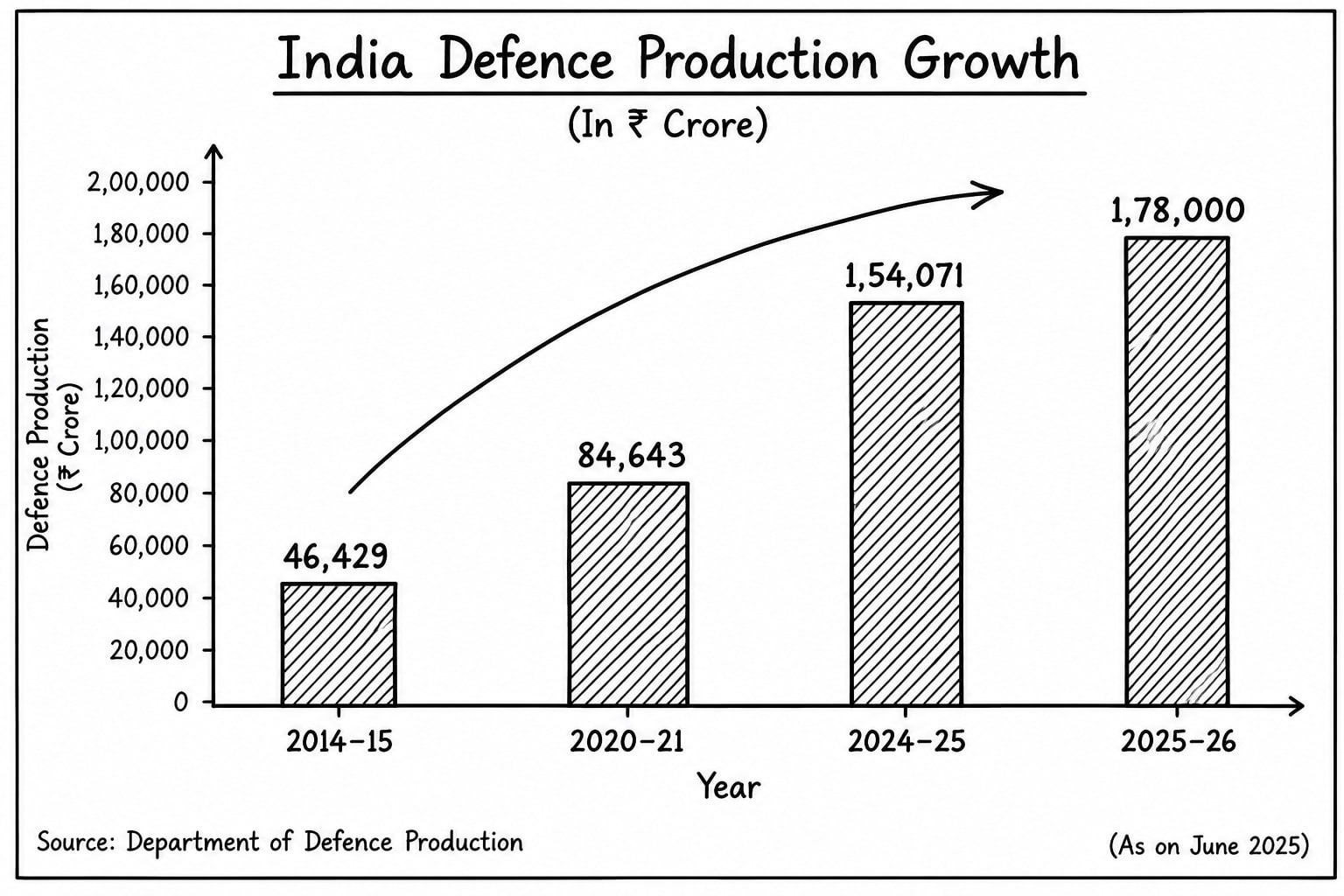
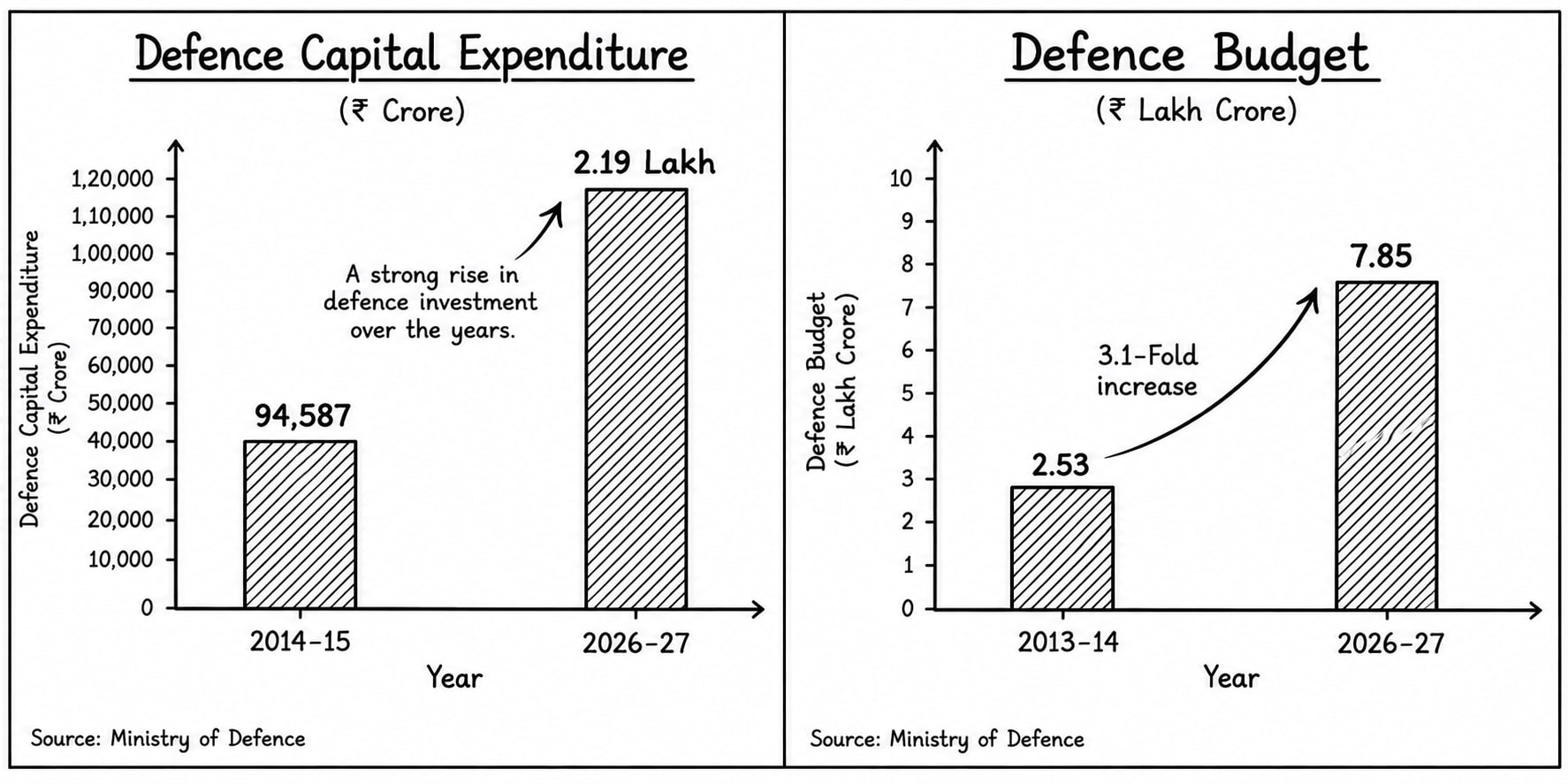
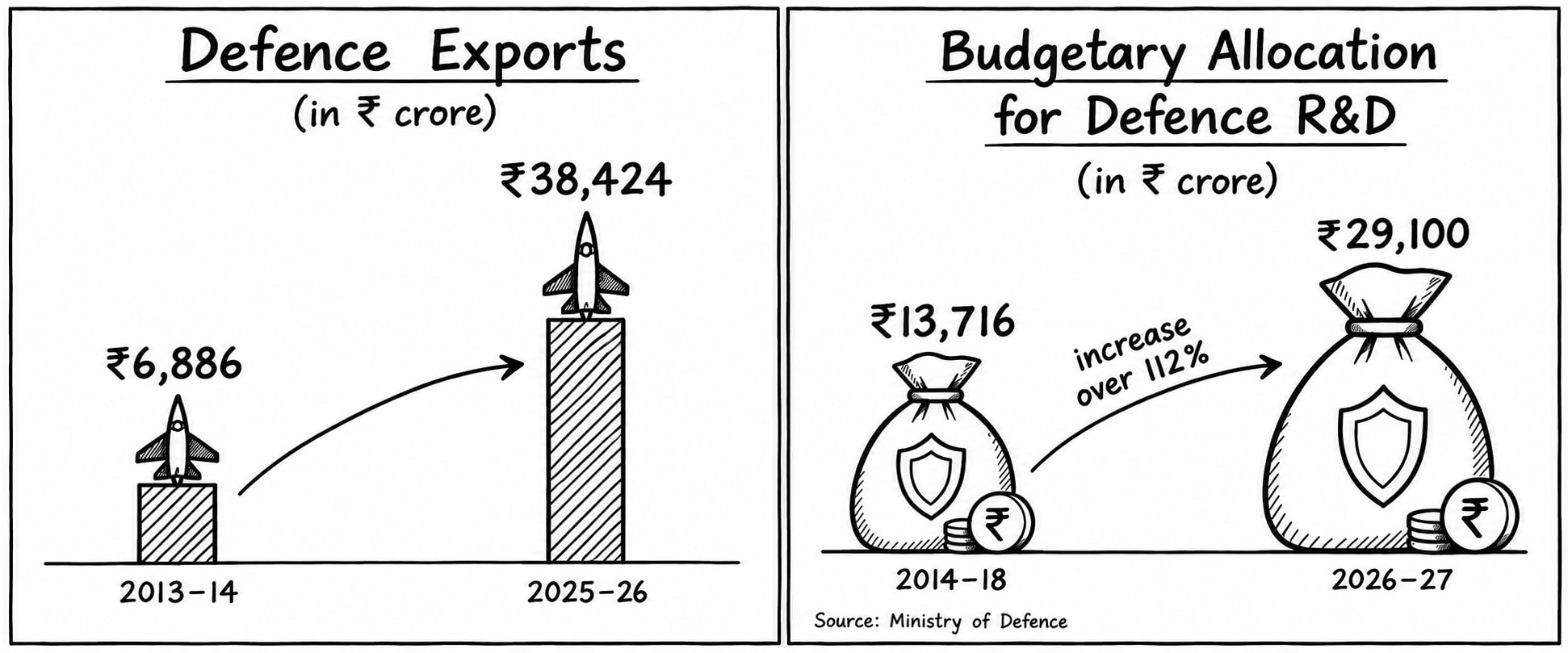
- Government has launched Make in India program which is crossing new milestone every year. For instance in the defence sector alone the defence production as reported in 2026 financial year have sowed 1.78 lac crore.
- In 2014-15, the defence production was merely 46 thousand crore. Defence exports in 2014 was 686 crore whereas in 2025-26 it is 38 thousand 424 crore. Export is reaching 80+ countries, which is a 5500% increase in 12 years.
- Government of India has launched Mission Mode project. In 2014 and before the ease of doing business ranking was 142 out of 185. The last data although government has been making their steps towards business ready world ranking, but in 2020 alone the World Bank ranked India 63 out of 185 countries.
- As per global reputed economic intelligence unit, India has been placed under top 10 countries for ease of doing business country. Number one being Singapore.
- Decentralization
- The centralized planning commission has been abolished and it has been replaced with thinktank called NITI Aayog which is focusing upon the idea of cooperative federalism that is walking working with the state.
- 14th Finance Commission increased the tax devolution of the divisible pool of state from 32% to 42% for year 2015-2020. It provides more finances. 15th Finance Commission more or less retained the same it is 41%, 1% for Jammu and Kashmir as it was under the President rule. In short it provides more freedom to states to initiates schemes based on local factors.