

Solar System
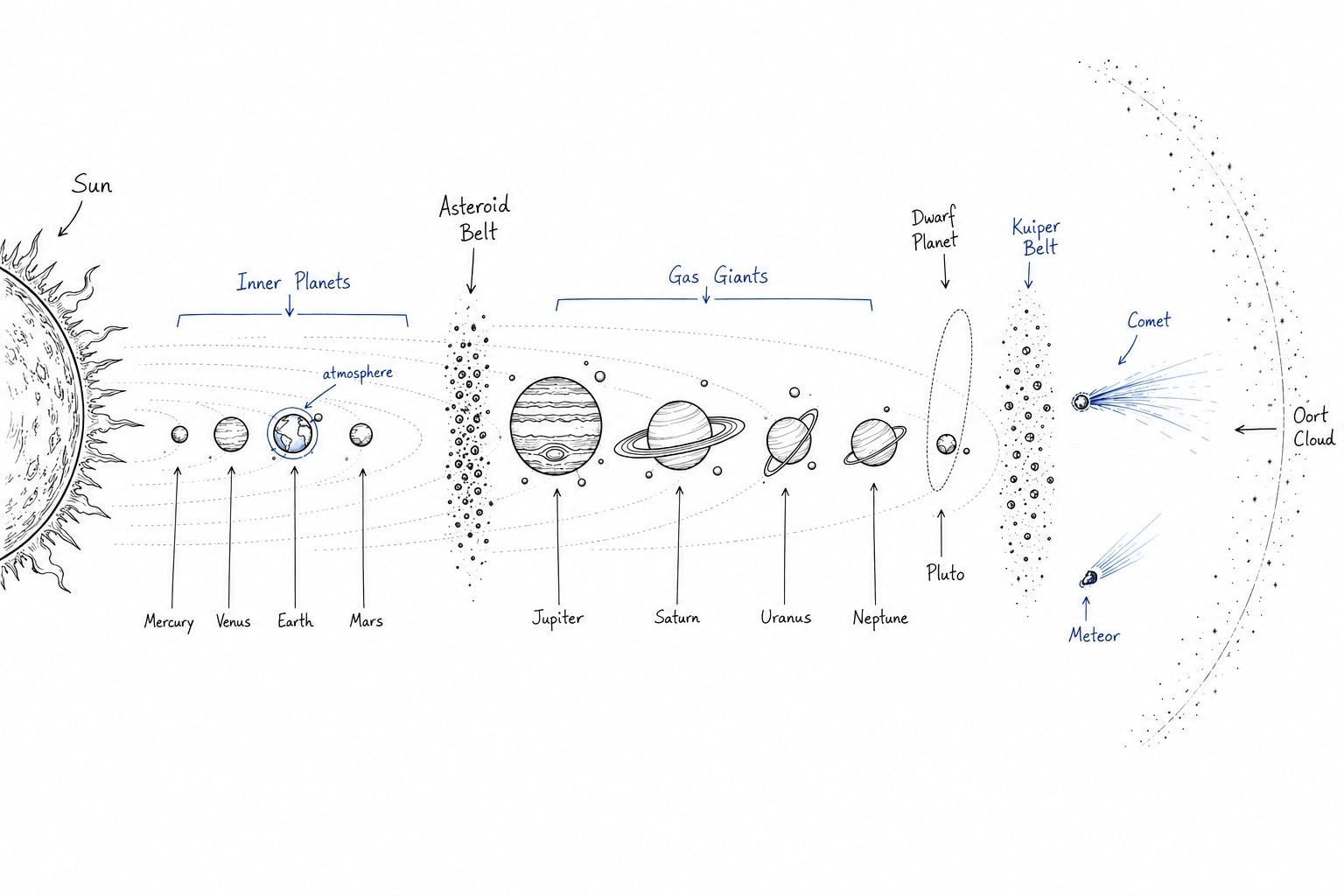
- Sun (Star)
- Planets (Satellites)
- Dwarf Planets
- Asteroids
- Meteors
- Comets
- Kuiper Belt
- Oort Cloud
Sun
Sun Spots
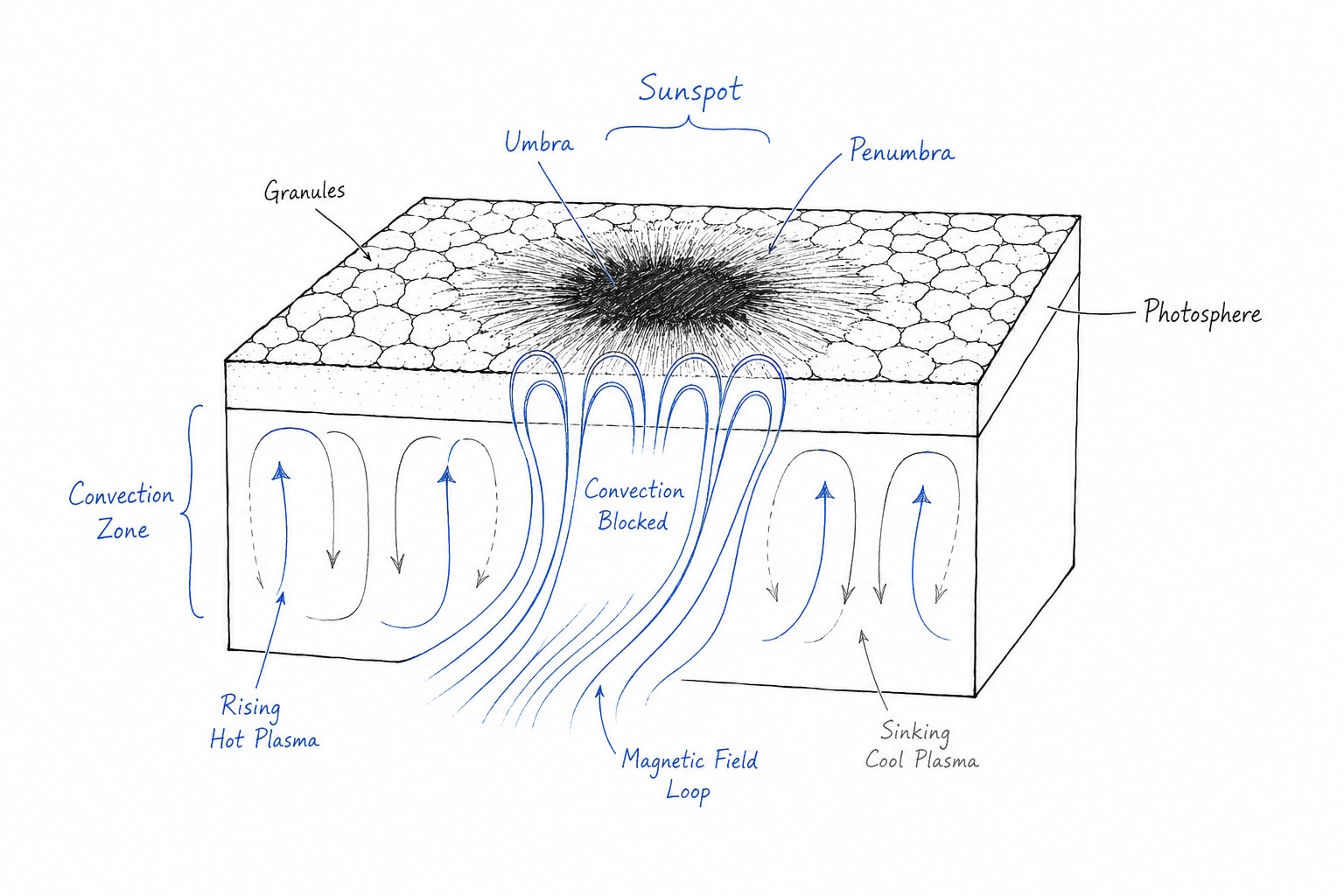
Sunspots are those special places developed on the Sun's surface which have abnormally high electromagnetic activity. As a result, these areas emit less heat than the average solar surface. These have relatively low temperatures. The darkest part in the centre of the sunspot is called the Umbra and the relatively less dark part is called the Penumbra.
Sunspot numbers rise from a minimum to a maximum in an 11-year cycle. In every 11th year, the Sun's magnetic polarity also reverses.
When sunspot numbers reach their maximum, the level of solar radiation is also generally higher, and vice versa.
Solar winds
Solar wind is a stream of plasma particles that are ejected from the Sun's atmosphere. They are caused by the Sun's magnetic field and they can cause Aurora on earth poles.
Solar Flares
Solar flares are intense bursts of radiation that is caused by the release of magnetic energy from sunspots.
Solar Prominence
These are enormous, arching structures of hot, glowing gas that extends from the Sun's surface to its outer atmosphere. They are often seen during total solar eclipse.
Planets
The heliocentric theory was given by Copernicus, and Kepler was the first to explain and prove that planets revolve around the Sun in elliptical paths. That is why there is a concept of Perihelion and Aphelion. Earth reaches aphelion on 4th July and perihelion on 3rd January.
Definition of Planet
-
Objects that revolve around the Sun
-
They should have sufficient gravity to give spherical shape
-
They must have cleared their orbital neighbourhood (of orbit)
Mercury
-
Mercury is the first planet from the Sun.
-
It is about 55% the mass of the earth.
-
It has about 38% of earth's gravity.
-
It has prograde rotation i.e. west to east.
-
It is the second hottest planet in the Solar System.
-
It has no moons.
Venus
-
It is the second planet from the Sun.
-
It is considered as earth's twin because of almost similar size and mass.
-
It has retrograde rotation i.e. east to west.
-
It completes its one rotation in 243 earth days i.e. the slowest rotation among the major planets.
-
It completes its one revolution in 225 earth days, thus a day is longer than the year on Venus.
-
Venus is the hottest planet of the Solar System because it has a very high concentration of greenhouse gases (CO2, i.e., about 96.5%). Venus's atmosphere contains sulfuric acid droplets; rain does not reach the surface because of the planet's extreme heat.
-
The average temperature of Venus is 465° C.
-
It is brightest planet also. It is called morning and evening star.
-
It is called goddess of beauty.
-
It has no natural satellites.
Earth
-
Third Planet.
-
Its average density is 5.5g/cm3.
-
Only planet where water is found in liquid state. It is because of its ideal temperature.
-
It has an ideal temperature because it is situated at an ideal distance from the Sun. This ideal distance is called the habitable zone or Goldilocks zone.
-
It has one natural satellite called moon.
-
Moon was formed 4.4 billion years ago whereas earth was formed 4.5 billion years ago.
-
the Moon revolves around the Earth in about 27 days, and it takes almost the same time to complete its rotation as well.
-
Earth's average orbital speed is about 30 km/s.
-
Escape velocity from the Earth is 11.2 km/s.
Mars
-
It is the fourth planet from the Sun.
-
It is called red planet because it contains red rock that is because of oxidation.
-
It completes one rotation in 24 hours and 37 minutes, which is very close to Earth's rotation (Earth sidereal day is 23 hours 56 minutes 4 seconds, Earth solar day is 24 hours )
-
Mars has 2 moons. Deimos and Phobos.
-
Earlier mars had strong magnetic field (billions of years ago) but now it does not have strong magnetic field.
-
Largest volcano of Solar System is Olympus Mons and this is on mars.
Jupiter
-
It is the fifth planet from the Sun.
-
It is gas giant
-
It has 318 times greater mass than the earth.
-
It has faint rings.
-
It has 95 moons
-
It is the largest planet of Solar System.
-
It is composed of hydrogen 90%, helium 10%. It has trace amounts of methane, ammonia and water vapour.
-
It completes one rotation in 9 hours 56 minutes. This makes it the fastest-rotating planet in the Solar System.
-
It completes one revolution in 11.86 years, or on average 12 years. That's why Kumbh Mela is celebrated after every 12 years at 4 places
1. Haridwar, Ganga river 2. Prayagraj, Ganga river 3. Ujjain, Shipra river 4. Nashik, Godavari river
- Its important moons are
- Io - most volcanically active body in the Solar System. - Europa - Ganymede - It is bigger than mercury. It is largest moon in the Solar System. - Callisto
Saturn
-
It is the sixth planet from the Sun.
-
It is gas giant.
-
It has prominent rings.
-
It has 270+ moons. Major moons are:
- Titan - It is the second largest moon of the Solar System, larger than Mercury.
- Enceladus - It is covered in ice.
- Rhea
- Iapetus
- Dione
- Mimas
-
Second largest planet in Solar System made of 96% hydrogen and 3% helium.
-
It completes one rotation in 10.7 hours, or about 10 hours 33 minutes.
-
It completes one revolution in 29.5 years.
-
On the North Pole of Saturn storms are developed in hexagon shape.
-
The density of Saturn is less than water
Uranus
-
Seventh planet
-
It is an ice giant.
-
It has 28 moons. Important moons are
- Titania - Largest moon of Uranus.
- Oberon
- Ariel
- Miranda
Most of the moons are named after characters from William Shakespeare's plays.
-
Its colour is blue-green. The reason behind the blue colour of Uranus is the high presence of methane gas. Methane gas absorbs red light and reflects blue-green light.
-
Uranus is third largest by diameter and fourth largest by mass.
-
Its rotation is retrograde, i.e., east to west like Venus.
-
It completes one rotation in 17 hours 14 minutes and its revolution in 84 years.
-
Uranus is tilted on its axis by about 98°.
-
It has also a faint ring.
Neptune
-
It is the eighth and farthest from the Sun.
-
It is an ice giant.
-
It has about 16 moons. Its famous moons are-
- Proteus
- Larissa
- Nereid
-
It has faint rings.
-
It is blue in colour.
-
It rotates west to east and completes its one rotation in 16 hours and completes one revolution in 165 Earth years.
-
Neptune experiences fastest wind blow of our Solar System sometimes faster than 2000 km/h.
Dwarf Planets
Dwarf planets are those which
-
revolve around the Sun
-
have spherical shape
-
but do not have a cleared orbit/neighbourhood.
There are five dwarf planets.
-
Pluto - Largest one.
-
Makemake
-
Haumea
-
Eris
These four lie in Kuiper Belt
- Ceres - Smallest dwarf planet.
It lies in asteroid belt
Asteroid Belt
The asteroid belt is a region of the Solar System that lies between Mars and Jupiter. It contains millions of rocky substances including ceres. These are also revolving around the Sun.
Meteors
Meteoroids are rocky bodies that enter Earth's atmosphere; the visible streak of light they produce is called a meteor. In the mesosphere, due to friction with the atmosphere, they catch fire, and they are called shooting stars. Most of them are completely burned and burn up, and only a few of them hit the Earth's surface. If a number of meteors come together and start burning in the mesosphere, it is called a meteor shower.
Comets
Comets are small celestial bodies primarily made up of ice and dust. When they approach the Sun while revolving, the coma becomes visible; this glowing head is called a coma. As the ice sublimates, they develop a tail, which is called a dust tail. The central solid part is the nucleus.
Comets come from mainly two places
-
the Kuiper Belt, which is located beyond Neptune. From here short period comets come
-
Oort Cloud - from here long period comets come with orbital periods greater than 200 years.
The famous Halley's Comet returns approximately every 76 years; it last appeared in 1986 and is expected again in 2061.
Oort Cloud
The Oort Cloud is a distant, roughly spherical cloud of icy bodies that surrounds the Solar System. It was proposed by Jan Oort in the 1950s.