and in China. His remains were buried in a church of Goa. He initiated the efforts for bringing the printing press to India which was brought in 1556 and was established at Saint Paul's Collage, Goa. He considered as the lord of Goa and an annual festival is celebrated for him even today by the people of Goa.
Factors Responsible for the decline of Portuguese power in India
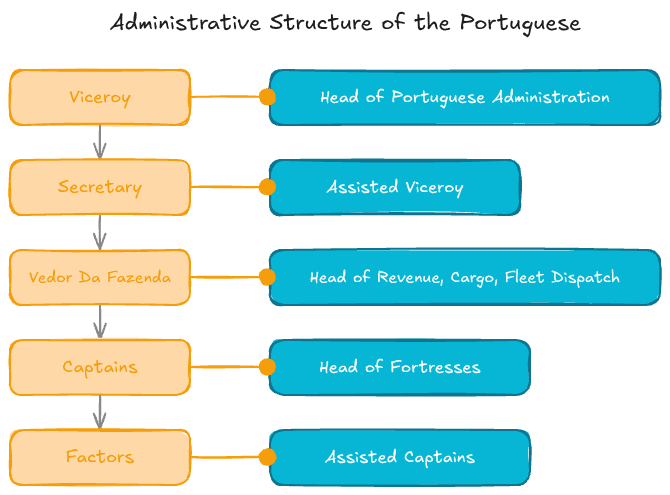
One of the major reason for decline was inefficiency and corruption found in the Portuguese administration system in India. The officials appointed to manage the affairs were incapable and corrupt. The lack of long term vision and their policies were primarily aim at extracting wealth rather than consolidating power.
The emergence of new European power become a threat to Portuguese supremacy. The Dutch, British and French arrived in India with superior military abilities and both organized commercial enterprise. The British defeated in the Battle of Swally, 1612. This battle mark the beginning of the end of Portuguese commercial monopoly over the Indian ocean region. The Dutch took over the Portuguese territories in Sri Lanka and Indonesia.
Another significant factor was the religious intolerance practiced by the Portuguese which caused strong discontent amongst the local population. It led to social unrest making it challenging for the Portuguese to maintain the political stability.
Unlike the British who systematically expanded their territorial control through alliances, wars and diplomacy, the Portuguese remain confined to their initial strong holds. They failed to established a vast inland empire and remain in the costal area. This limited territorial presence make them vulnerable to attacks and reduce their political influence.
The Portuguese remains culturally isolated from the Indian people. The racial arrogance prevented them from integrating with the local culture which was essential for long term dominance.
The Portuguese Contributions
The Portuguese introduced several new crops and commodities in India which have a lasting impact on Indian culture and cuisine, notably among them were red chilies, cashew nuts, tabacoo, pineapple, papaya, guava.
The Portuguese were key players in trade of Indian textile particularly cotton fabrics which was highly valued in Europe and spread across Asia. The Portuguese played a major role in the spread of Christianity particularly Catholicism. The Christian missionaries such as St. Francis Xavier were active in converting the local population specially in Goa, Kerala and parts of Tamil Naidu.
The Portuguese presence in India led to cultural synthesis in the region were we had strong presence such as Goa. The Portuguese language made a strong impact on Konkani language spoken in Goa which we find many Portuguese words. Similarly the Goa cuisine with dishes like Vindaloo, Bebinca reflect a fusion of Indian and Portuguese tradition.
The Portuguese colonial architecture left a significant impact on India. The construction of church, forts and houses in the Indo-Portuguese style is a hall mark of the Portuguese. The notable examples includes Basilica on Bom Jesus, the Sea Cathedral and the church of St. Cajetan in Goa which are UNISCO recognized world heritage site.
The art of printing first came to India when the Portuguese brought the printing press in the 16th century. The 1st book printed in Indian language was Thambiran Vanakkam published in Tamil. It was 16 page translation of a doctrine on Christianity.
Dutch
The Dutch were the people of Netherlands who came to India in the form of a company that means The Dutch East India Company established in 1602. This company is considered as the first Multi-national company and the first company to issue stocks. It was established under the leadership of the Dutch statesman Johan van Oldenbarnevelt. It played an important role in establishing Dutch colonial rule in the parts of Asia including the present day Indonesia.
Unlike the Portuguese who focused primarily on trade in species, the Dutch focus mainly on trade in textile from the Coromandel Coast region. Apart from textiles they also trade items like indigo, rice, opium, saltpeter. The first Dutch settlement in India was found at Masulipatnam (Andhra Pradesh) in 1605. The land for the settlement was granted by sultan of Golconda. Later they founded another settlement as Devanampattinam (Tamil Naidu) which come to be known as the Fort St. David under the British. Pulicat was another important Dutch settlement established in 1692 where they build their headquarters. Later they transfer their headquarters in Negapatam in 1687.
The Dutch founded several minor settlement in western India at places such as Surat, Bharuch, Bombay and Ahmedabad. They established their factory in Patna in 1632 to trade in saltpeter which was an essential ingredient in making gun powder. Later they established a factory at Chinsurah (Fort Gustavus) at Kasim Bazar. The position of Dutch in India depended on the superiority of their naval power. They broke the Portuguese monopoly by using naval power but they failed against the British. In the Battle of Bedara, 1759 the British forces defeated the Dutch finally by the Anglo-Dutch treaty of 1824, Netherlands surrender all their possessions on the Indian subcontinent and the rights associated with them to the British.
In terms of their impact upon India the Dutch are given the credit of popularizing the trade in Coromandel Chintz that means a primitive multi color fabric with glazed finished. They also contributed to the Indian architecture by constructing the Tombs at cemetery in Surat and Kasim Bazar.
Britishers
The coming of British to India Ralph Fitch an English merchant and traveler was one of the first British to visit India and other part of Asia. His visit in India took place in 1583 during the regime of the Mughal emperor Akbar.
In 1600 a group of English merchant who called themselves "Merchant Adventurous" formed a company name the Governor and Company of Merchants of London Trading into the East Indies. The company was issued a charter by the British queen Elizabeth I on 31st Dec 1600 with the rights of exclusive trade in East Indies. The charter initially gave the company a 15 year monopoly on trade. In 1609 a new charter extended the monopoly rights of the company for a indefinite period.
By the late 17th century the company faced a rival in the form of "General Society trading to the East Indies". It was another British company formed in 1698. In 1702 the two rivals companies merged under the name "The United Company of Merchants of England trading to the East Indies". This merger was facilitated by an act of parliament. However, despite the formal change in name, the popular name "English East India Company" continued.
Major Settlement of English East India Company in India
In 1608 captain William Hawking visited India, he arrived at Surat in a ship name Hector. he visited to the Mughal court at Agra and was received with all Indian hospitality the emperor Jahangir. He was able to prosecute the emperor to grant the British permission for establishing a factory at Surat but the permission was soon withdrawn due to influence of Portuguese in the Mughal court. However the victory of British forces over Portuguese at Swally in 1612 broke the tradition of Portuguese naval supremacy and a farman was issued by Jahangir permitting the English to establish a factory at Surat in 1613.
The British company established first factory in India in 1611 at Masulipatnam. However the factory was temporary later they established their first permanent factory at Surat. Later in 1619 they established another factory at Broach present day Bharuch in Gujrat and Ahmedabad.
In 1615, Sir Thomas Roe come to India as a companies representative and live in Agra till 1619. He succussed in getting two farman one from Jahangir and second form his son Khurram which gave permission to trade and build factories in different parts of Mughal empire.
By 1630, Surat become the companies headquarters on the western coast on India. It was finally replaced by Bombay as the headquarter of company in 1687. In 1662 Portuguese gave Bombay as a part of dowry to their princess Catherine of Braganza on her marriage with Charles II, the king of England. The company took Bombay from Charles II in 1668 on lease. Gerald Aungier the companies governor of Bombay from 1669 to 1677 is the true founders of the Bombay's greatness. It was during his tenure that small island town of Bombay was converted into a promising hub for Thomas.
In peninsular India, company began his trade with the establishment of settlement at Masulipatnam in 1611. In 1639 the companies servant Francis Day obtained the site of Madras from Venkata Raya the king of Vijayanagar. Here company built fort St. Gorge. Madras replaced Masulipatnam as the headquarters of the company on the Coromandel cost in 1641.
In the eastern coast of India the British established their first factories at Balasore and Hariharpara in Odisha in 1633. Later they also formed their establishment at Hugli, Patna, Dhaka and Kasim Bazar. The major commodities of export by the company from the Bengal in the middle of 18th century were cotton and silk textile, saltpeter and opium. Job Charnock the companies employ established on English factory at Sutanuti in Bengal in 1691. He is regarded as the founder of the city of Kolkata. In 1698 the company was permitted by Azim-ush-Shan (Governor of Bengal) to purchase the Zamindari of 3 villages of Sutanuti, Kalikata and Govindpur. This marked the foundation of Calcutta where British established fort William and which became the British capital in 1722.
Danish
The days followed the Portuguese the Dutch and the British they came to India as a company in 1616. After landing on the Indian mainland the Dutch company established their settlement in the town of Tranquebar (Tharangambadi, Tamil Naidu). The Dutch settlement established here in 1620 and it come to be known as fort Dansborg. Later they established their settlement at Frederiksnagore (present day Srirampur in Bengal). This place served as the Danish headquarter in India.
Later in 1799 the Christian missionary William Corey, William Ward and Joshua Marshman together known as Serampore Trio established a press at this place which play a significant role in education and printing Christian literature in India.
Unlike the other European counter parts the Danish trading operation in India were on a much smaller scale. They had few trading posts and factories which restricted their abilities to control the trade route and markets. They lack military resources and manpower. Unlike British and French who formed strategic alliances with powerful local rulers and played a significant role in the political affairs of the Indian kingdom, the Danish did not established strong political relationship with the Indian rulers.
Ultimately the British took over the possessions of Danish settlements in India when Danish sold their port at Serampore in 1839 and Tranquebar in 1845.
The French
The French East India company was founded in 1664 under the patronization of king Loui XIV and his finance minister Jean Colbert. It established it's first settlement in India in 1667 at Surat and 1674 at Pondicherry as their headquarters in India and they built fort St. Loui at this place. Before the French the Portuguese were the first European to established their settlement at Pondicherry which later under the control of Dutch till 1654. The Frenchman who is given the credit of transferring Pondicherry into major settlement is Francois Martin.
In Bengal the French laid the foundation of their major settlement at Chandan Nagar in 1690. At a place granted to them by Shaista Khan (The Mughal subedar of Bengal).
The appointment of Dupleix as the French Governor General in India in 1742 led to beginning of Anglo-French conflict which resulted in Carnatic wars (1749-1763).
The first Carnatic War (1746-48) was resulted to the war of the Austrian succession where Britain and France were from the opposite side. It ended with the Treaty of Aix La Chapelle. Under the treaty Madras was return to British and peace was restored in India.
The Second Carnatic War (1749-54) was the result of the interference of English East India Company and French English East India Company in the dispute of succession in Carnatic and Hyderabad. In the Carnatic the British supported Md. Ali and the French supported Chanda Sahab. In Hyderabad the British supported Nasir Jung and French supported Muzaffar Jung. The two important battle of this war were:
- Battle of Ambur, 1749
- Battle of Areot, 1751
The war ended in 1754 with the Treaty of Pondicherry which established Md. Ali as the nawab of Carnatic and Salabat Jung (Allie of French) as the nizam of Hyderabad.
The third Carnatic war (1757-63) was part of seven year war fought between the Britain and France. One of the most decisive battle of this war was the Battle of Wandiwash in which British forces the command of Sir Eyre Coote defeated the French forces under the command of Count de Colly was ended with Treaty of Paris 1763 that ended French supremacy position over the Indian subcontinent.
Battle of Plassey
The Battle of Plassey fought on 23rd June 1757 was a decisive conflict between the English East India Company and the nawab of Bengal Siraj-ud-Daula. This battle marked the beginning British political dominance in India.
The British company wanted to expand its commercial interest in India. They were keen on securing favorable trading conditions. Siraj-ud-Daula who became the nawab of Bengal stop the company form misuse of its power and privileges. This created on immediate background for the conflict between nawab and company.
Before the Battle of Plassey Clive of can conspired with Mir Zaffar (Commander of the nawab's army) on the date of the Battle of Clive carefully plant the military strategy for confronting the forces of Siraj-ud-Daula. Moreover, a heavy sudden monsoon rain struck the battle field and this unexpected rain became a critical turning point in battle directly favoring Britishers.
The battle commenced on 23rd June 1757 Nawab's forces were significantly larger than the British. However, Mir Zaffar and his troops abstained form fighting. This act betrays weakened the army of Siraj-ud-Daula. Therefore the British despite less being in numbers secured decisive victory due to their diplomacy and betrayal within the Siraj-ud-Daulah nobility.
The victory at Plassey marked the beginning of British political dominance in India. Mir Zaffar became the nawab of Bengal but he was puppet ruler controlled by the British. This victory gave the company significant advantage allowing them to dictate terms to the nawab and effectively control Bengal's administration. The Battle's after mark showed the transfer of immense wealth to the company. The victory enhance the companies military and strategic position in India. The battle also demonstrated the effectiveness of the European diplomacy against a larger Indian force setting a president for the future conflict.
Battle of Buxar
Battle of Buxar was fought on 22nd Oct 1764 between the English East India Company and the allied forces of Mir Qasim, Shah Alam II and Shuja-ud-Daulah. The primary cause of the battle was the conflict between the company and Mir Qasim for control over Bengal. It is said that Mir Qasim was the last nawab of Bengal who tried to rule independent. In 1763, the company removed Mir Qasim and appointed Mir Zaffar as the nawab of Bengal which created a immediate cause for the battle.
In the Battle the allied forces were defeated by the company forces fighting under the command of Major Hector Manuro. The Battle proof itself to be a turning point in the history of Bengal in particular and India in general. The British after battle became the undisputed and the real masters of Bengal, Bihar and Odisha.
In 1765, Shuja-ud-Daulah and Shah-Alam II signed the treaties of Allabhad with Robert Khalif (Governor of Bengal). In the first treaty of Allabhad signed with Shuja-ud-Daulah, the nawab had to pay a compensation of ₹ 53 lakh and surrender the territories of Kara and Allabhad. In the second treaty of Allabhad with Shah Alam II, the Mughal emperor had to grant the British Diwani rights of Bengal, Bihar, Odisha in exchange of ₹ 26 lakh/annum to be paid by the company to Mughal Emperor. After the battle during the period of period of 1765-1772 the form of government witness in Bengal has been called the dual government of Bengal. Under this form of government company got all the power without any responsibility whereas the nawab and Mughal emperor had all the responsibilities without any power. As the Diwan the company was authorized to collet the revenue. The company appointed Md. Raza Khan and Raja Shitab Rai on the post of deputy diwan to collect the revenue because the nawab of Bengal was the puppet to the company. The company also enjoy the Nizamat rights i.e. Right to maintain law and order. In this context company appointed Md. Raza Khan as deputy Nizam. Later in 1772, Warren Hastings abolished the dual system of government and Bengal was brought under the direct control of the British.