European Penetration in India - Portuguese, Dutch, British & French Rivals for UPSC
UPSC Modern History notes on European penetration in India - arrival, trading settlements, naval power, and rivalry among Portuguese, Dutch, French, and British.
The first Portuguese sailor to reach India through a new sea route was Vasco da Gama, who arrived on 21
May 1498. He landed at Calicut, which is considered one of the major landmarks in the history of India's trade with Europe. After him, the second Portuguese sailor to come to India was Pedro Álvares Cabral in 1500. He established a factory at Calicut, which became the first European factory in India.
Later, the first Portuguese fort was built at Kochi in Kerala in 1503. It was named Fort Emmanuel. The Portuguese first established their headquarters at Kochi on the Malabar Coast. Later, they shifted their headquarters to Goa in 1530.
In 1505, the Portuguese king established the Estado da Índia, which was one of the earliest and longest-lasting European colonial enterprises in Asia. The objectives of establishing a Portuguese empire in India were to trade in spices and textiles and to spread Christianity. Later, the Portuguese brought much of the Indian Ocean region under their control through the system of Cartazes, i.e., navigation permits that ships had to obtain from Portuguese authorities to sail in the Indian Ocean region.
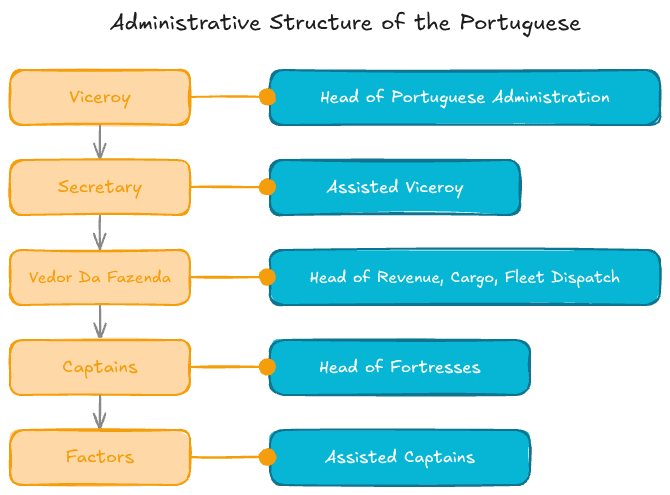
The affairs of the Estado da Índia were managed by a Portuguese governor appointed by the Portuguese Crown. These governors had extensive powers to manage the military, administrative, and commercial affairs of the Portuguese in the Indian Ocean region. Below the governors, captains and other officials were responsible for administering different territories and implementing and managing the Crown's policies.
The Portuguese also aimed to spread Christianity. Christian missionaries were active in converting Indians and establishing churches and educational institutions. The Portuguese established a separate tribunal called the "Goa Inquisition" in 1560, which continued until 1812. The Inquisition primarily focused on enforcing Christianity among Indians through torture, imprisonment, death penalties, and intimidation.
Portuguese Governors in India
In 1505, Francisco de Almeida was appointed the first Portuguese governor in India. He remained in office from 1505 to 1509. He introduced the Blue Water Policy, which aimed to strengthen Portuguese naval supremacy and control over India's spice trade through the Indian Ocean region. His vision was to turn the Indian Ocean into a Portuguese sea. The systematic control exercised by the Portuguese over trade between India and Europe brought them into conflict with the Egyptians, Arabs, Turks, and several Indian kingdoms. This led to a series of battles, some of the most important being:
The Battle of Cannanore, 1506
The Battle of Chaul, 1508
The Battle of Diu, 1509
The Battle of Diu was the most decisive battle fought between the Portuguese Empire and the combined fleet of the Sultan of Gujarat, the Sultan of Egypt, and the Zamorin of Calicut. The Portuguese emerged victorious, and the grand Islamic alliance was defeated. This victory established Portuguese naval supremacy over the Indian Ocean region and marked the beginning of European colonialism in Asia.
The second Portuguese governor was Afonso de Albuquerque. He served as the Portuguese governor from 1509 to 1515. He is considered the real founder of Portuguese power in India. In 1510, he captured Goa from the Bijapur Sultanate. He built a Portuguese fort at Bhatkal in Karnataka with the permission of the Vijayanagara ruler, Krishnadeva Raya. He abolished the practice of Sati in Goa. He died in 1515 while returning to Portugal.
Another prominent Portuguese governor in India was Nuno da Cunha. He held the position from 1529 to 1538. He signed the Treaty of Bassein in 1534 with Sultan Bahadur Shah of Gujarat, who ceded the island of Bassein, including the surrounding areas, to the Portuguese. He established Goa as the Portuguese headquarters in 1530.
Martim Afonso de Sousa was the Portuguese governor from 1542 to 1545. During his tenure in India, the Christian missionary St. Francis Xavier, who was also a co-founder of the Society of Jesus (Jesuits), visited India in 1542. He learned the local language and made sincere efforts to convert thousands of people to Christianity. He died in 1552 on an island in China. His remains were later brought to Goa and buried in a church there. He initiated efforts to bring the printing press to India, which arrived in 1556 and was established at St. Paul's College, Goa. He is considered the patron saint of Goa, and an annual festival is celebrated in his honour even today by the people of Goa.
Factors Responsible for the Decline of Portuguese Power
One of the major reasons for the decline was the inefficiency and corruption prevalent in the Portuguese administration in India. The officials appointed to manage its affairs were often incapable and corrupt. The lack of a long-term vision and policies primarily aimed at extracting wealth rather than consolidating power further weakened Portuguese rule.
The emergence of new European powers became a threat to Portuguese supremacy. The Dutch, British, and French arrived in India with superior military capabilities and better-organised commercial enterprises. The British defeated the Portuguese in the Battle of Swally in 1612. This battle marked the beginning of the end of the Portuguese commercial monopoly over the Indian Ocean region. The Dutch took over Portuguese territories in Sri Lanka and Indonesia.
Another significant factor was the religious intolerance practised by the Portuguese, which caused strong discontent among the local population. It led to social unrest, making it challenging for the Portuguese to maintain political stability.
Unlike the British, who systematically expanded their territorial control through alliances, wars, and diplomacy, the Portuguese remained confined to their initial strongholds. They failed to establish a vast inland empire and remained concentrated in coastal areas. This limited territorial presence made them vulnerable to attacks and reduced their political influence.
The Portuguese remained culturally isolated from the Indian people. Their racial arrogance prevented them from integrating with local culture, which was essential for long-term dominance.
Portuguese Contributions
The Portuguese introduced several new crops and commodities to India that had a lasting impact on Indian culture and cuisine. Notable examples included red chillies, cashew nuts, tobacco, pineapple, papaya, and guava.
The Portuguese were key players in the trade of Indian textiles, particularly cotton fabrics, which were highly valued in Europe and widely traded across Asia. They also played a major role in spreading Christianity, particularly Catholicism. Christian missionaries, such as St. Francis Xavier, were active in converting the local population, especially in Goa, Kerala, and parts of Tamil Nadu.
The Portuguese presence in India led to cultural synthesis in regions where they had a strong presence, such as Goa. The Portuguese language had a significant impact on Konkani, spoken in Goa, which contains many Portuguese words. Similarly, Goan cuisine, with dishes such as Vindaloo and Bebinca, reflects a fusion of Indian and Portuguese traditions.
Portuguese colonial architecture left a significant impact on India. The construction of churches, forts, and houses in the Indo-Portuguese style is a hallmark of Portuguese influence. Notable examples include the Basilica of Bom Jesus, Se Cathedral, and the Church of St. Cajetan in Goa, which are UNESCO-recognised World Heritage sites or form part of the UNESCO-listed heritage area.
The art of printing first came to India when the Portuguese brought the printing press in the 16
century. The first book printed in an Indian language was Thambiran Vanakkam, published in Tamil. It was a 16-page translation of a Christian doctrinal text.
Dutch
The Dutch were the people of the Netherlands who came to India through a company known as the Dutch East India Company, established in 1602. This company is considered one of the earliest multinational corporations and the first company to issue shares. It was established under the leadership of the Dutch statesman Johan van Oldenbarnevelt. It played an important role in establishing Dutch colonial rule in parts of Asia, including present-day Indonesia.
Unlike the Portuguese, who focused primarily on the spice trade, the Dutch focused mainly on trading textiles from the Coromandel Coast region. Apart from textiles, they also traded in items such as indigo, rice, opium, and saltpetre. The first Dutch settlement in India was established at Masulipatnam (Andhra Pradesh) in 1605. The land for the settlement was granted by the Sultan of Golconda. Later, they established another settlement at Devanampattinam (Tamil Nadu), which came to be known as Fort St. David under the British. Pulicat was another important Dutch settlement, established in 1610, where they built their headquarters. Later, they transferred their headquarters to Negapatam in 1687.
The Dutch founded several smaller settlements in western India at places such as Surat, Bharuch, Bombay, and Ahmedabad. They established their factory in Patna in 1632 to trade in saltpetre, which was an essential ingredient in making gunpowder. Later, they established a factory at Chinsurah (Fort Gustavus) and at Kasimbazar. The position of the Dutch in India depended on their naval superiority. They broke the Portuguese monopoly by using naval power but failed to maintain their dominance against the British. In the Battle of Bedara in 1759, the British forces defeated the Dutch. Finally, under the Anglo-Dutch Treaty of 1824, the Netherlands surrendered its possessions on the Indian subcontinent and the rights associated with them to the British.
In terms of their impact on India, the Dutch are credited with popularising the trade in Coromandel chintz, a multicoloured cotton fabric with a glazed finish. They also contributed to Indian architecture by constructing tombs and cemetery structures in Surat and Kasimbazar.
Britishers
The arrival of the British in India began with visits by English merchants and travellers. Ralph Fitch, an English merchant and traveller, was one of the first Englishmen to visit India and other parts of Asia. His visit to India took place in 1583, during the reign of the Mughal emperor Akbar.
In 1600, a group of English merchants who called themselves "Merchant Adventurers" formed a company named the Governor and Company of Merchants of London Trading into the East Indies. The company was issued a charter by the English queen Elizabeth I on 31
December 1600, granting it exclusive trading rights in the East Indies. The charter initially gave the company a 15-year monopoly on trade. In 1609, a new charter extended the company's monopoly rights for an indefinite period.
By the late 17
century, the company faced a rival in the form of the "General Society Trading to the East Indies". It was another English company formed in 1698. In 1702, the two rival companies merged under the name "The United Company of Merchants of England Trading to the East Indies". This merger was facilitated by an Act of Parliament. However, despite the formal change in name, the popular name "English East India Company" continued to be used.
Major Settlements of the English East India Company in India
In 1608, Captain William Hawkins visited India and arrived at Surat aboard a ship named Hector. He visited the Mughal court at Agra and was received with great hospitality by the emperor Jahangir. He was able to persuade the emperor to grant the British permission to establish a factory at Surat, but the permission was soon withdrawn due to Portuguese influence at the Mughal court. However, the victory of British forces over the Portuguese at Swally in 1612 broke the tradition of Portuguese naval supremacy, and a farman was issued by Jahangir, permitting the English to establish a factory at Surat in 1613.
The British company established its first factory in India in 1611 at Masulipatnam. However, this factory was temporary. Later, they established their first permanent factory at Surat. In 1619, they established additional factories at Broach (present-day Bharuch) in Gujarat and Ahmedabad.
In 1615, Sir Thomas Roe came to India as the company's representative and lived in Agra until 1619. He succeeded in obtaining two farmans, one from Jahangir and the second from his son Khurram, which granted permission to trade and establish factories in different parts of the Mughal Empire.
By 1630, Surat had become the company's headquarters on the western coast of India. It was finally replaced by Bombay as the company's headquarters in 1687. In 1662, the Portuguese gave Bombay as part of the dowry of their princess Catherine of Braganza on her marriage to Charles II, the king of England. The company took Bombay from Charles II on lease in 1668. Gerald Aungier, the company's governor of Bombay from 1669 to 1677, is considered the true founder of Bombay's greatness. During his tenure, the small island town of Bombay was transformed into a promising commercial hub.
In peninsular India, the company began its trade with the establishment of a settlement at Masulipatnam in 1611. In 1639, the company's servant Francis Day obtained the site of Madras from Venkata Raya, the king of Vijayanagara. Here, the company built Fort St. George. Madras replaced Masulipatnam as the company's headquarters on the Coromandel Coast in 1641.
On the eastern coast of India, the British established their first factories at Balasore and Hariharpur in Odisha in 1633. Later, they also established settlements at Hugli, Patna, Dhaka, and Kasimbazar. The major commodities exported by the company from Bengal in the middle of the 18
century were cotton and silk textiles, saltpetre, and opium. Job Charnock, the company's employee, established an English factory at Sutanuti in Bengal in 1691. He is regarded as the founder of the city of Kolkata. In 1698, the company was permitted by Azim-ush-Shan, the Governor of Bengal, to purchase the zamindari rights of three villages: Sutanuti, Kalikata, and Govindpur. This marked the foundation of Calcutta, where the British established Fort William. It later became the British capital in 1772.
Danish
Following the Portuguese, Dutch, and British, the Danes came to India through a company established in 1616. After arriving on the Indian mainland, the Danish company established its settlement in the town of Tranquebar (Tharangambadi, Tamil Nadu). The Danish settlement was established here in 1620 and came to be known as Fort Dansborg. Later, they established a settlement at Frederiksnagore (present-day Serampore in Bengal). This place served as the Danish headquarters in India.
Later, in 1799, the Christian missionaries William Carey, William Ward, and Joshua Marshman, together known as the Serampore Trio, established a press at this place. It played a significant role in education and the printing of Christian literature in India.
Unlike their European counterparts, the Danes conducted trading operations in India on a much smaller scale. They had only a few trading posts and factories, which restricted their ability to control trade routes and markets. They lacked military resources and manpower. Unlike the British and French, who formed strategic alliances with powerful local rulers and played significant roles in the political affairs of Indian kingdoms, the Danes did not establish strong political relationships with Indian rulers.
Ultimately, the British took over the Danish settlements in India after the Danes sold their settlement at Serampore in 1845 and Tranquebar in 1845.
The French
The French East India Company was founded in 1664 under the patronage of King Louis XIV and his finance minister, Jean-Baptiste Colbert. It established its first settlement in India in 1667 at Surat and another at Pondicherry in 1674, which became its headquarters in India. The French built Fort St. Louis at this place. Before the French, the Portuguese were the first Europeans to establish a settlement at Pondicherry, which later came under Dutch control until 1654. The Frenchman credited with transforming Pondicherry into a major settlement was François Martin.
In Bengal, the French laid the foundation of their major settlement at Chandernagore in 1690, at a place granted to them by Shaista Khan, the Mughal Subahdar of Bengal.
The appointment of Dupleix as the French Governor-General in India in 1742 led to the beginning of the Anglo-French conflict, which resulted in the Carnatic Wars (1749–1763).
The First Carnatic War (1746–1748) resulted from the War of the Austrian Succession, in which Britain and France were on opposing sides. It ended with the Treaty of Aix-la-Chapelle. Under the treaty, Madras was returned to the British, and peace was restored in India.
The Second Carnatic War (1749–1754) resulted from the interference of the English and French East India Companies in succession disputes in Carnatic and Hyderabad. In Carnatic, the British supported Muhammad Ali, while the French supported Chanda Sahib. In Hyderabad, the British supported Nasir Jung, while the French supported Muzaffar Jung. The two important battles of this war were:
Battle of Ambur, 1749
Battle of Arcot, 1751
The war ended in 1754 with the Treaty of Pondicherry, which established Muhammad Ali as the Nawab of Carnatic and Salabat Jung, an ally of the French, as the Nizam of Hyderabad.
The Third Carnatic War (1757–1763) was part of the Seven Years' War fought between Britain and France. One of the most decisive battles of this war was the Battle of Wandiwash, in which British forces under the command of Sir Eyre Coote defeated the French forces under the command of Count de Lally. The war ended with the Treaty of Paris in 1763, which ended French political supremacy over the Indian subcontinent.
Battle of Plassey
The Battle of Plassey, fought on 23
June 1757, was a decisive conflict between the English East India Company and the Nawab of Bengal, Siraj-ud-Daulah. This battle marked the beginning of British political dominance in India.
The British company wanted to expand its commercial interests in India. It was keen on securing favourable trading conditions. Siraj-ud-Daulah, who became the Nawab of Bengal, sought to prevent the company from misusing its power and privileges. This created the immediate background for the conflict between the Nawab and the company.
Before the Battle of Plassey, Robert Clive conspired with Mir Jafar, the commander of the Nawab's army. On the day of the battle, Clive carefully planned his military strategy for confronting the forces of Siraj-ud-Daulah. Moreover, heavy and sudden monsoon rain struck the battlefield, and this unexpected rain became a critical turning point in the battle, directly favouring the British.
The battle commenced on 23
June 1757. The Nawab's forces were significantly larger than those of the British. However, Mir Jafar and his troops abstained from fighting. This act of betrayal weakened the army of Siraj-ud-Daulah. Therefore, despite being fewer in number, the British secured a decisive victory due to their diplomacy and the betrayal within Siraj-ud-Daulah's nobility.
The victory at Plassey marked the beginning of British political dominance in India. Mir Jafar became the Nawab of Bengal, but he was a puppet ruler controlled by the British. This victory gave the company a significant advantage, allowing it to dictate terms to the Nawab and effectively control Bengal's administration. The aftermath of the battle witnessed the transfer of immense wealth to the company. The victory enhanced the company's military and strategic position in India. The battle also demonstrated the effectiveness of European diplomacy against a larger Indian force, setting a precedent for future conflicts.
Battle of Buxar
The Battle of Buxar was fought on 22
October 1764 between the English East India Company and the allied forces of Mir Qasim, Shah Alam II, and Shuja-ud-Daulah. The primary cause of the battle was the conflict between the company and Mir Qasim over control of Bengal. Mir Qasim is often regarded as the last Nawab of Bengal who attempted to rule independently. In 1763, the company removed Mir Qasim and appointed Mir Jafar as the Nawab of Bengal, creating an immediate cause for the battle.
In the battle, the allied forces were defeated by the company's forces fighting under the command of Major Hector Munro. The battle proved to be a turning point in the history of Bengal in particular and India in general. After the battle, the British became the undisputed masters of Bengal, Bihar, and Odisha.
In 1765, Shuja-ud-Daulah and Shah Alam II signed the Treaties of Allahabad with Robert Clive, the Governor of Bengal. Under the first Treaty of Allahabad, signed with Shuja-ud-Daulah, the Nawab had to pay compensation of ₹53 lakh and surrender the territories of Kara and Allahabad. Under the second Treaty of Allahabad, Shah Alam II, the Mughal emperor, granted the British the Diwani rights of Bengal, Bihar, and Odisha in exchange for ₹26 lakh per annum, to be paid by the company to the Mughal emperor.
After the battle, during the period 1765–1772, the form of government that existed in Bengal was known as the Dual Government of Bengal. Under this system, the company had all the power without any responsibility, whereas the Nawab and the Mughal emperor had all the responsibilities without any power. As the Diwan, the company was authorised to collect revenue. The company appointed Muhammad Raza Khan and Raja Shitab Rai as deputy diwans to collect revenue because the Nawab of Bengal was a puppet ruler controlled by the company. The company also exercised Nizamat rights, i.e., the right to maintain law and order. In this context, the company appointed Muhammad Raza Khan as deputy Nazim. Later, in 1772, Warren Hastings abolished the Dual Government system, and Bengal was brought under the direct control of the British.
This study guide requires sign-in.
Unlock this full article plus 500+ structured UPSC study notes & instant PDF exports.