

Origin and Evolution of Earth
Big Bang Theory
The most widely accepted scientific theory explaining the origin of the universe is the Big Bang Theory. It was proposed by Georges Lemaître, a Belgian physicist in 1927. According to this theory, The universe began about 13.8 billion years ago after a big explosion that is called Big Bang.
-
Before Big Bang the present universe was confined into an atom-sized speck/ ball.
-
This was the stage of singularity. Singularity means the stage when space, time, and matter as we know them did not exist.
-
During this time there was infinite pressure, temperature, and density.
-
The four fundamental forces that govern the entire universe were also combined together. They include:-
- Gravity:- Gravity pulls objects with mass towards each other. This force keeps planets in orbit around stars.
- EM-force:- It acts between electrically charged particles. It is responsible for lightning, electricity, etc.
- Strong Nuclear force:- It binds quarks together to form protons and neutrons. Without this force atoms could not exist.
- Weak Nuclear force:- It plays a key role in nuclear reactions. It converts one type of particle into another. It causes certain types of radioactive decay.
-
About 13.8 billion years ago, this atom-sized speck started expanding, this event is called the Big Bang.
-
The expansion of this universe was initially relatively slow. This period is called the Planck era (from 0 to 10-43 second).
-
After the Planck era, the universe expanded enormously in a tiny fraction of seconds, that is, about 10-36 to 10-32 seconds. This phase is called the phase of cosmic inflation.
-
Thereafter, the universe continued expanding even at the present but with relatively slower speed.
-
Due to continuous expansion, the universe's density, temperature, and pressure decreases, in other words, cooling of the universe started.
-
After the Big Bang, the fundamental forces also got separated. gravity became a distinct fundamental force.
-
Due to cooling of the universe, electrons, protons, and neutrons were formed, which later combined to form the first atoms. The first element was hydrogen, followed by helium.
-
The large clouds of Hydrogen, Helium led to the formation of galaxies and stars, and this way The universe began.
Main Evidence
-
Redshift theory:- It was proposed by Edwin Hubble in 1929. According to this theory, when a source of light moves away from an observer, its light waves get stretched and the wavelength becomes longer and shifts towards the end of the visible spectrum. Hubble observed that the stars of the distant galaxies are moving away from the US, thus the universe is expanding.
-
Cosmic Microwave Background Radiation:- It was proposed by Wilson and Penzias in 1965. They found that Cosmic Microwave Background Radiation is left over thermal radiation from the early universe. Because of this radiation, the temperature of the universe is 2.7 K, which is nearly the same temperature in all directions. It means the universe had an origin.
-
Presence of light Elements in the universe:- It is one of the strongest evidence for the Big Bang. According to this, the universe is filled with hydrogen (75% by mass) and helium (25% by mass).
Limitations
-
Cannot explain singularity.
-
Cannot explain what happens before the Big Bang.
-
Was there only the Big Bang or multiple Big Bangs, Only universe or multiverse?
Steady State Theory of Origin of Universe
It was proposed in 1948 by Hoyle, Bondi and Gold. According to this
-
Universe has always existed and will always exist; i.e., it is permanent.
-
The universe is expanding, but its overall appearance remains the same over time.
-
The galaxies move apart, new matter is continuously created in empty space to maintain a constant average density.
Difference between Big Bang Theory and Steady State Theory
| Big Bang Theory | Steady State Theory |
|---|---|
| Universe had a beginning 13.8 billion years ago | Universe is permanent it has no beginning or end |
| Density of universe decreases as universe expands | Density remains constant even though universe expands because of continuous creation formation of new matter |
| No continuous creation of matter | Continuous creation of new matter |
| It shall have an end (Big Crunch) | No beginning and no end |
Steady State Theory has now been completely discarded especially after discovery of cosmic microwave background radiation.
Galaxies
- Galaxies are huge groups of stars or vast collection of stars, planets, gas, dust, etc. held together by the gravity. There are 3 types of galaxies:
1. Spiral Shape Galaxy:- Such galaxies have arms e.g. Milky Way galaxy has 6 arms. Our Solar System lies in Orion Arm. Similarly our nearest galaxy Andromeda.
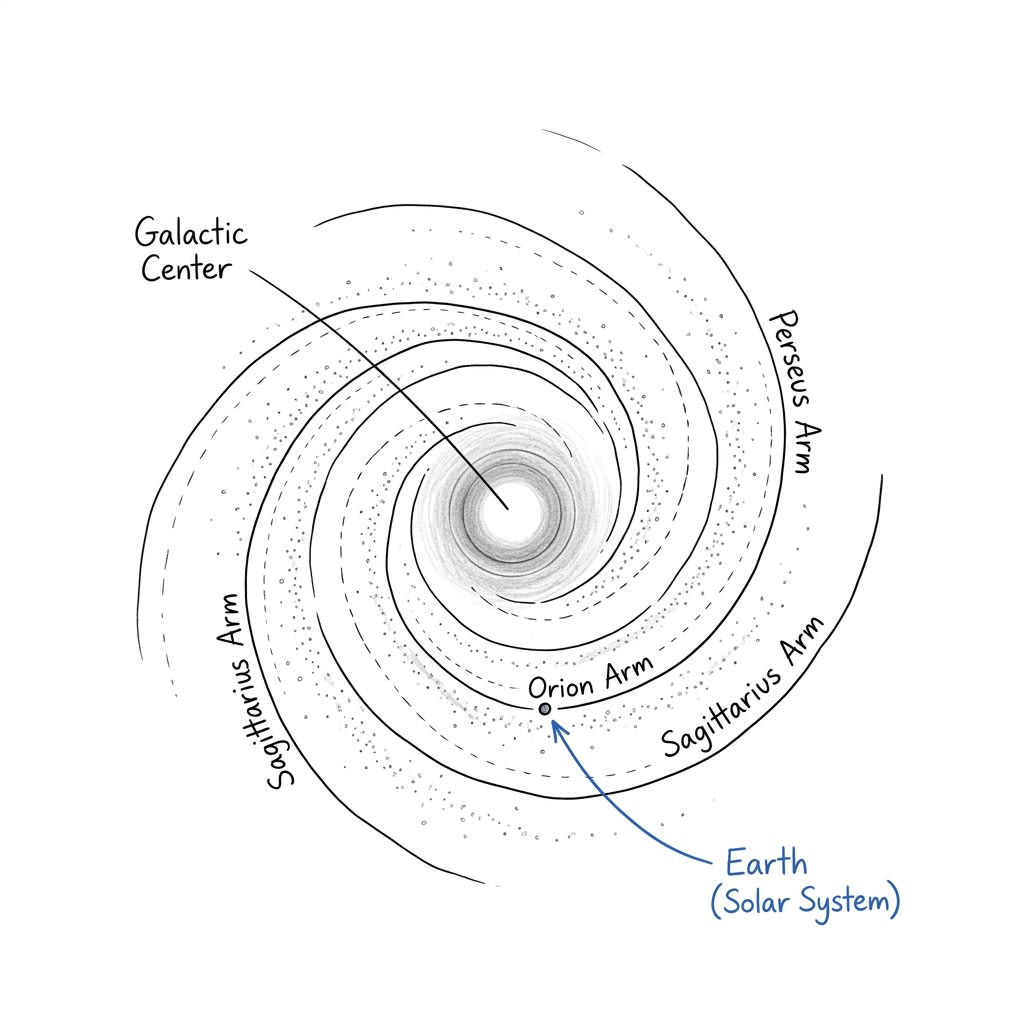
Milky Way
2. Elliptical Shape:- e.g. Cygnus A
3. Irregular shape Galaxies:- Such galaxies do not have any particular shape e.g. Magellanic Clouds Large and Small. These two galaxies are satellite galaxies of the Milky Way.
-
There is high gravity in the centre of galaxy which are mostly black holes e.g. name of the black hole present in the centre of the galaxy, Milky Way, is Sagittarius A.
-
Stars form in regions of gas and dust within galaxies, often called stellar nurseries.
-
Quasar is one of the brightest object in universe. It is extremely bright centre powered by supermassive black hole.
-
Our Milky Way galaxy is a part of Local Group, which contains many dozens of galaxies. Local group is part of Virgo Supercluster.
-
Virgo Supercluster is part of Laniakea Supercluster. Eventually part of Pisces-Cetus Supercluster Complex.
Stars
Stars are those celestial bodies which have their own light which comes out due to nuclear fusion which takes place at the core of the star. The life cycle of a star is as follows:-
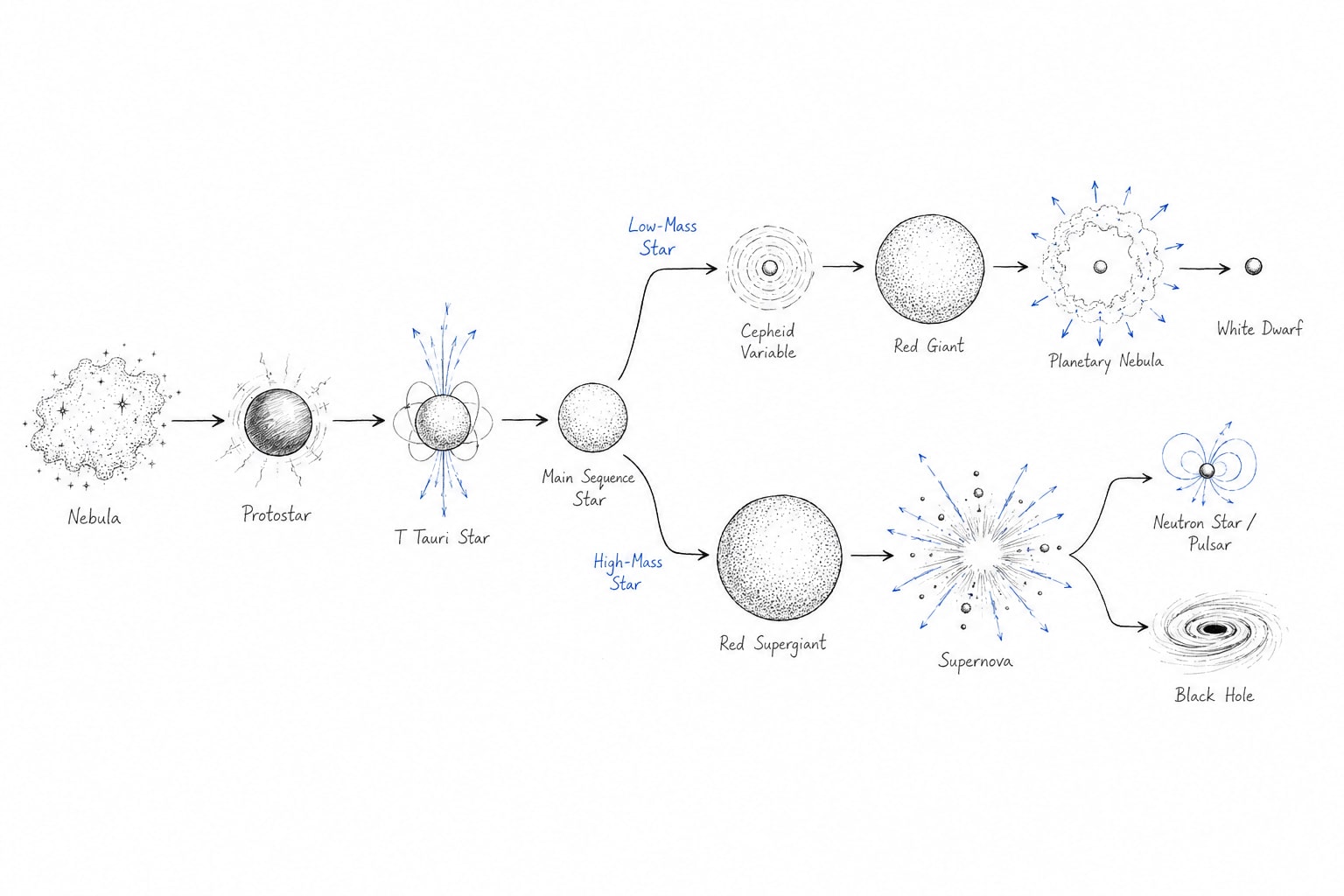
Nebula
Star forming Nebula is a vast cloud of gas and dust in space where new stars are born. Gravity causes parts of the cloud to collapse which forms a Protostar out of the Nebula.
Protostar
A Protostar is a young, developing star formed when a dense region within a Nebula collapses under gravity. It is not yet a true star because nuclear fusion has not started in its core. As it contracts and heats up, it eventually reaches the temperature needed for fusion.
T Tauri Stage
It is a very young star in the final stage before becoming a Main Sequence star. It has an age usually less than 10 million years.
Main Sequence Star
A main sequence star is a stable star that produces energy by converting hydrogen into helium in its core through nuclear fusion. This is the longest stage in the star lifecycle. Our sun is in Main Sequence star stage.
Our Sun had become a Main Sequence star about 4.5 billion years ago.
Cepheid Variable:- It is not a separate stage in the life cycle of all stars. It is a type of pulsating star that is usually found after the main sequence phase. The star repeatedly expands and contracts, causing its brightness to vary regularly.
Red Giant and Super Red Giant Star
-
Red Giant:- Small and medium-sized stars, which lose their fuel gradually, with masses of up to about eight solar masses enter into the stage of red giant. In this stage, the star becomes much larger than the main sequence star.
-
Super Red Giant:- Large stars which consume their fuel faster than small stars, with masses greater than about eight solar masses enter into the stage of super red giant. In this stage, the size of the star becomes very large due to nuclear fusion of heavier elements like helium, carbon, oxygen, etc., in successive stages.
Planetary Nebula Stage
Small stars enter into this stage after red giant stage. At this stage, a small core remains at the centre and the outer periphery gradually blows away.
White Dwarf
It is the end stage of small stars.
Supernova Explosion Stage
After the super-red-giant stage, massive stars may undergo a supernova explosion, i.e., a supermassive explosion. It produces and disperses heavy elements such as iron, gold, uranium, etc.
Neutron Star
It can form when the mass of the dying star is 8 to 25 solar masses.
Pulsar Star
It is subtype of neutron star. Neutron stars are made up of neutrons. A rotating neutron star that emits beams of radiation is called a pulsar.
Black Hole
It is the end stage of a dying star if its mass is more than 25 solar masses (20 to 25 solar masses). Black holes are the reason for massive gravity; even light cannot escape. Nothing can escape after crossing the event horizon of a black hole. The centre of a black hole is called the singularity.