

Geomorphology
- Earth's interior
- Continental Drift theory
- Plate Tectonics theory
- Volcanic
- Earthquake
- Mountains, Plateaus, Plains
- Weathering and Erosion
- Rock and Rock cycle
- Landforms by
- Rivers
- Winds
- Glaciers
- Ground Water
- Coastal waves
Earth's interior
According to the various theories explaining origin of Solar System and planets the Earth also came out from the same nebula which had formed our solar sun. The important theories include
-
Nebular Hypothesis: It is most accepted hypothesis today it was given Immanuel Kant in 1755. It was later developed by Laplace in 1796. Its main idea is that the Solar System was formed from a rotating cloud of gases and dust called Nebula. The gravity caused the centre of nebula to collapse. It formed sun at the centre and the remaining materials formed planets.
-
Planetesimal Hypothesis: It was proposed by Chamberlin in 1905.
-
Tidal Hypothesis: It was proposed by James Jeans and Jeffreys in 1917.
-
Binary star Hypothesis: It was proposed by Russell.
-
Dust Cloud Hypothesis: It was proposed by Gerard Kuiper.
If we consider any of these hypotheses as correct, and knowing that the Earth was formed 4.5 billion years ago as a hot semi-molten mass that later solidified, we might expect the Earth's surface to be a smooth, plain surface, but it is not so. the The Earth's surface is highly irregular and contains many relief features, mainly due to endogenic forces operating from the Earth's interior.
Study of Earth's interior
The centre of the Earth which is called core has a depth 6370 km no technology can lead the US to such depth to make direct observation. This is why scientists used both direct and indirect methods to understand the Earth's interior because reaching the core directly is not currently possible.
Direct Methods
-
Deep Mining:- With current scientific tools and technology, we have reached up to the depth of 8 to 12 km only. However, they suggest that temperature and density increase with depth.
-
Study of temperature:- with increasing depth temperature increases by 1°C/32m but this rate of increase in temperature is restricted only up to 8km beyond that temperature increases but with relatively slower rate. That's why calculation suggest that at the depth of core temperature is about 5000 to 5500°C.
Causes of such high temperature
- Trapped primordial heat from the formation of the Earth in its interior.
- Concentration of radioactive elements like Uranium and Thorium which decay and produce a large amount of heat. The maximum concentration of radioactive elements is in the upper mantle.
- Conversion of gravity into heat.
-
Study of Pressure:- pressure increases with depth. Pressure is the force per unit area applied upon the lower surface by the overlying surface. This is why core bears maximum pressure followed by mantle followed by crust. To be more precise inner core maximum pressure followed by outer core, lower mantle, upper mantle, lower crust and upper crust.
with increase in pressure
- temperature increases with increasing depth
- melting point of the rocks also increases.
- with increasing depth density of rocks gradually increases This is why their melting point is also high, e.g., the topmost layer of the Earth's surface is made up of silica and aluminium that has least density the middle layer is made up of silica and magnesium whereas innermost part is made up of nickel and ferrous.
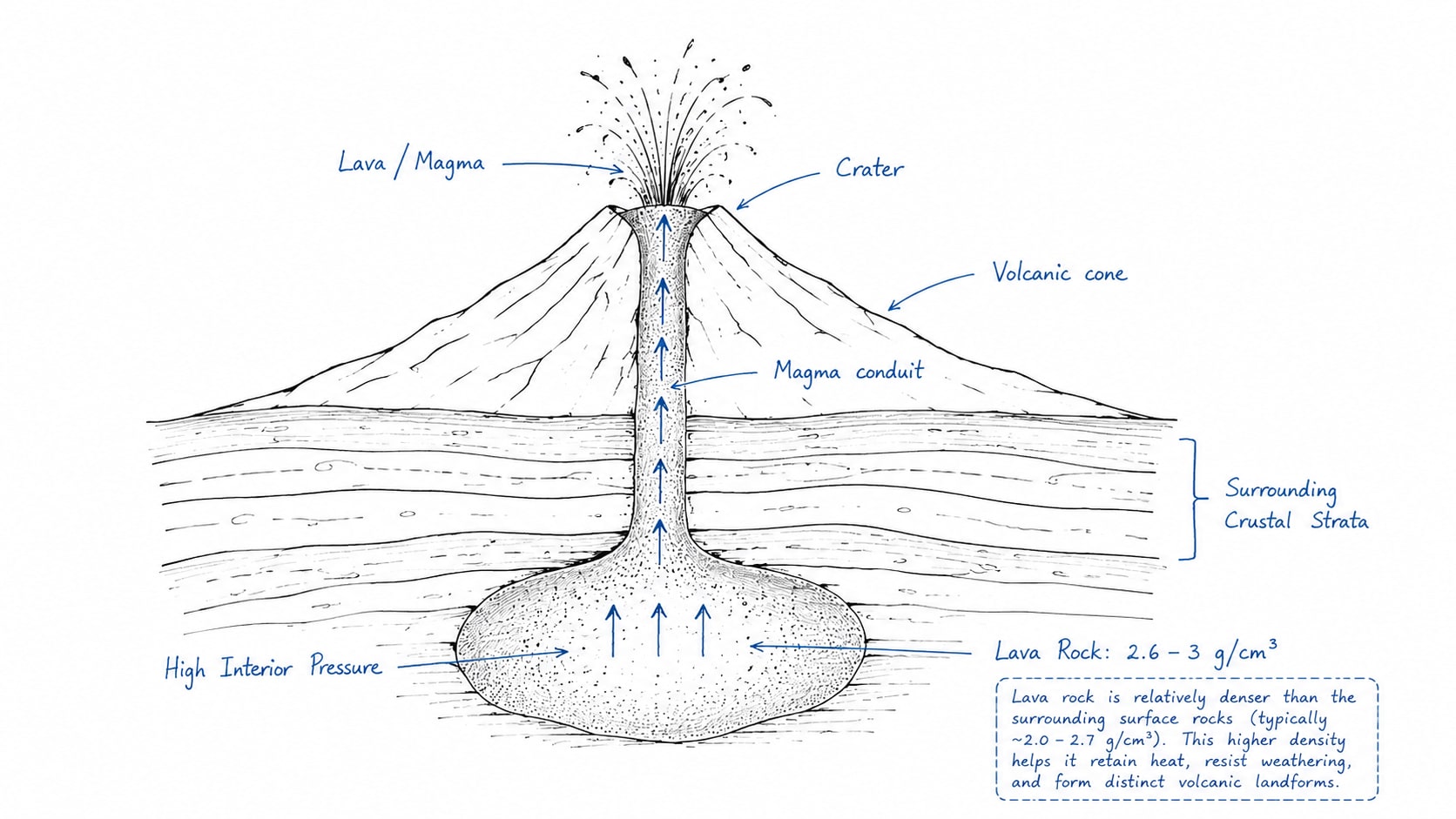
Rocks at the Earth's surface have an average density of 2.6 g/cm3 to 3 g/cm3 whereas the core has 10–30 g/cm3 This is why average density of 5.5 g/cm3
Indirect methods
-
Study of Meteors Meteors help the US in gaining direct observation. Meteors are rocks flying in space attracted by earth's gravity and hit the surface of earth as a solid mass. Meteors are the remnants of the past which reveals the process of formation of Solar System as well as earth. In 99% cases these meteors are made up of iron and nickel which gives clear indication that the Earth's core should also be made up of iron and nickel.
-
Study of Volcanism A volcanic eruption is the eruption of molten rocks from the interior with burst which suggests that temperature, pressure, and density generally increase with depth inside the Earth
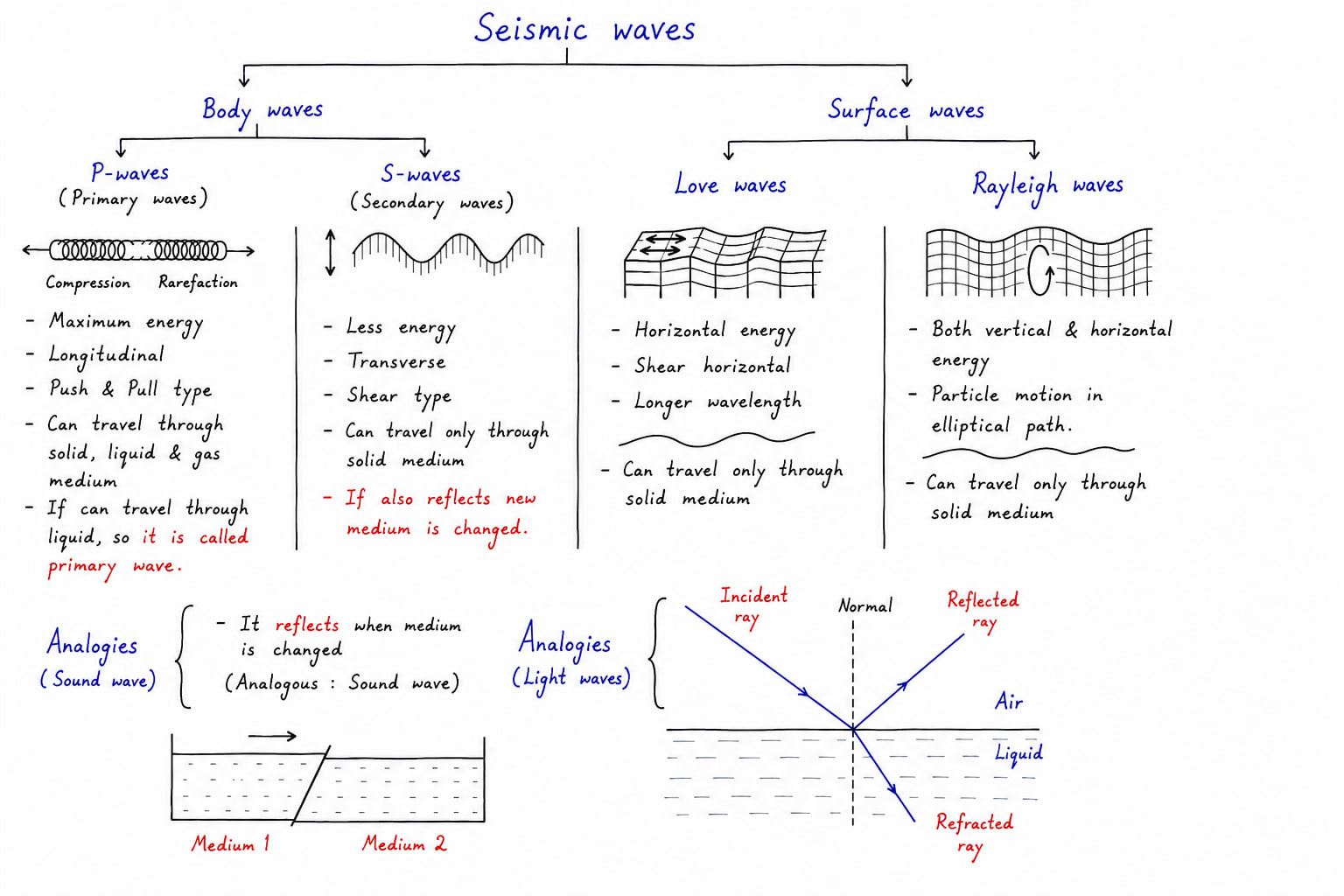
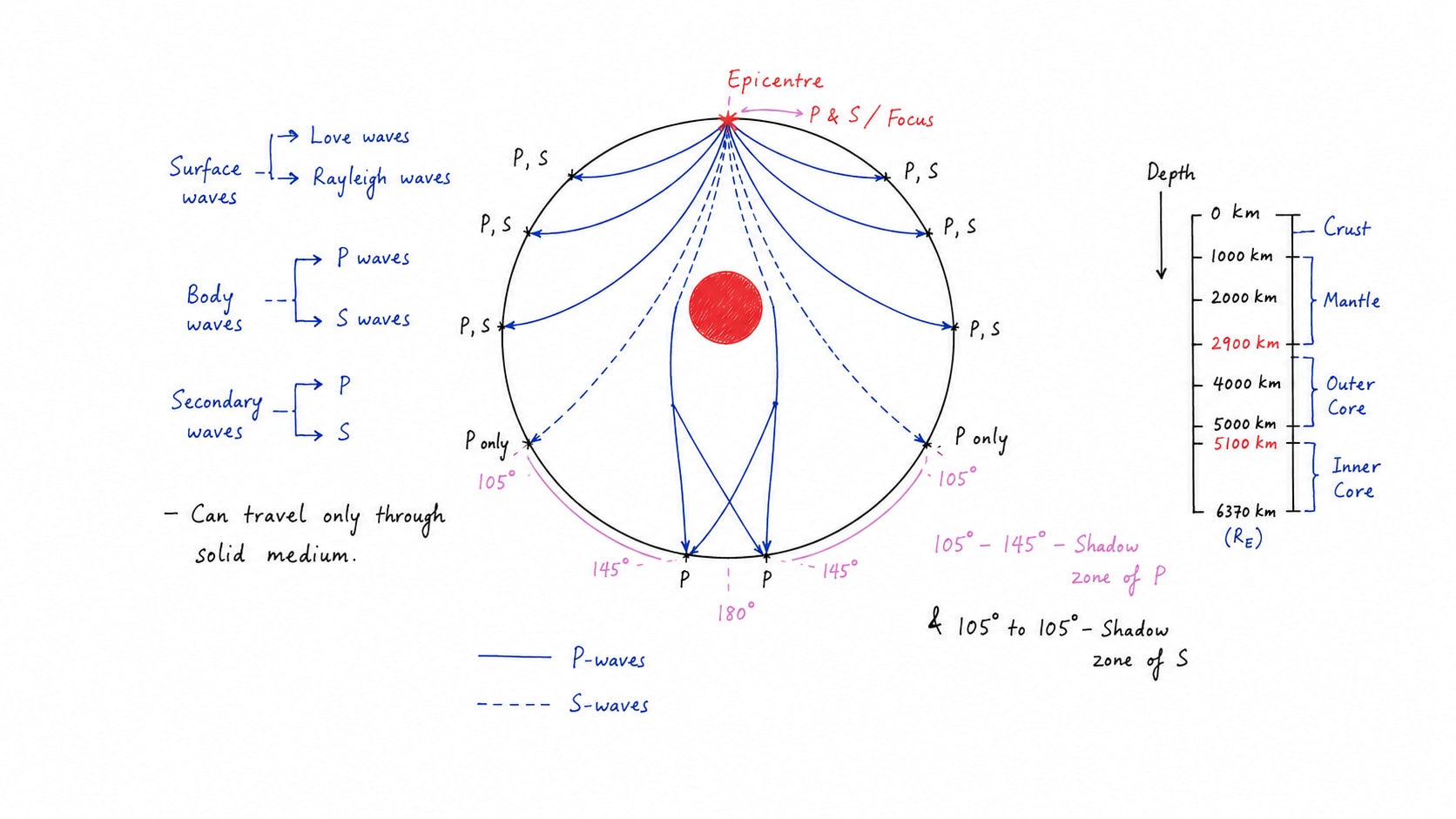
- Study of Seismic waves Seismic waves are most effective method to know about interior because this is the only method to pass through the entire interior of earth. Seismic waves are of two types:- 1. Surface waves:- Surface waves originate from the epicentre and do not travel through the interior of the Earth. They travel only on the surface. These are of two types L waves and R waves 2. Body waves:- Body waves originate from the focus and travel only through the interior. These are of two types: 1. Primary waves or P wave - Primary waves carry maximum energy and have maximum velocity and shortest wavelength. - It can pass through solid, liquid, and gaseous media. - It refracts when the medium changes. 2. S waves - S waves carry lesser amount of energy and velocity than the P and its wavelength is also longer than P. - It can travel only through a solid medium. - It also refracts when the medium changes.
Structure of Earth's interior
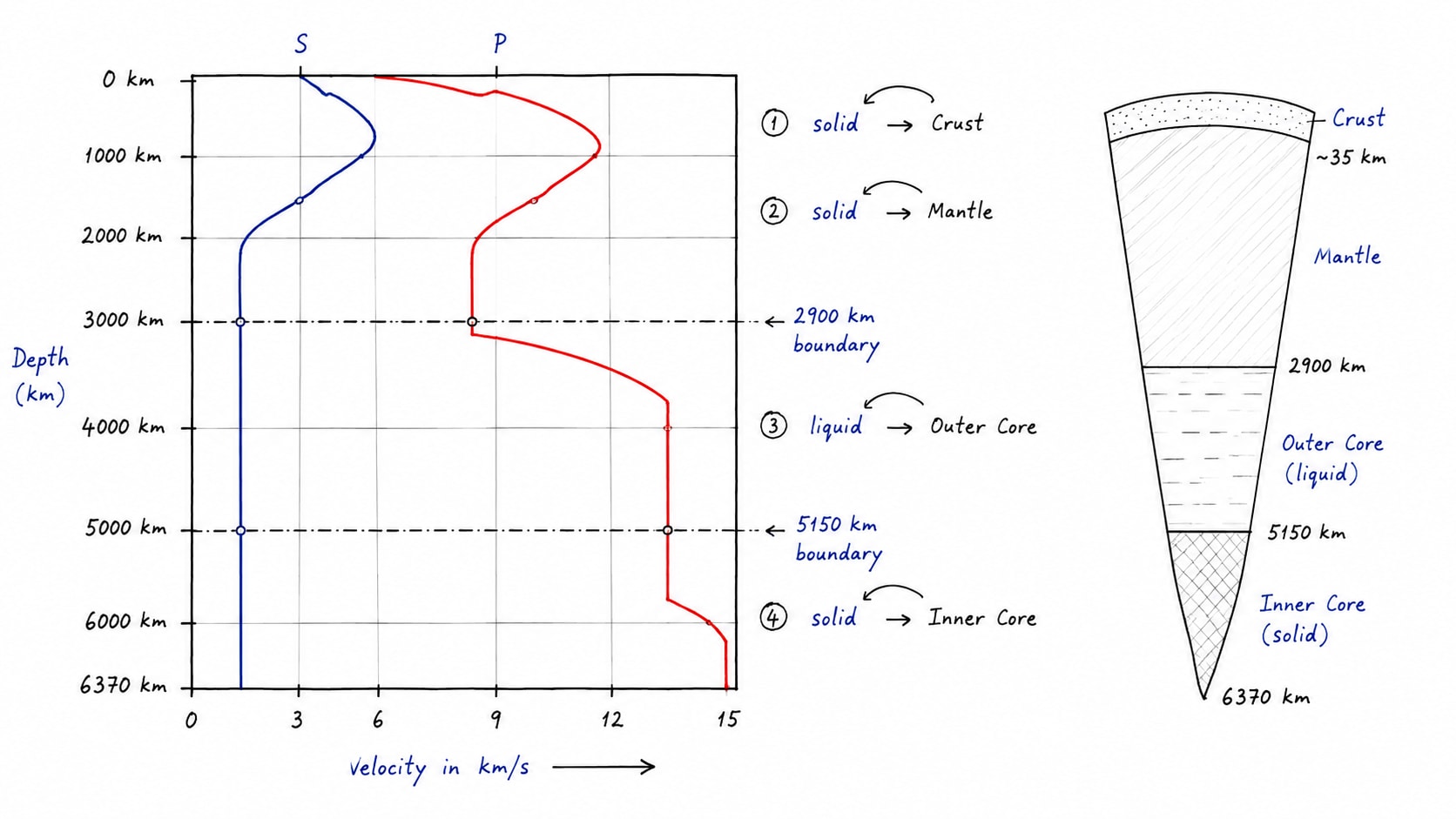
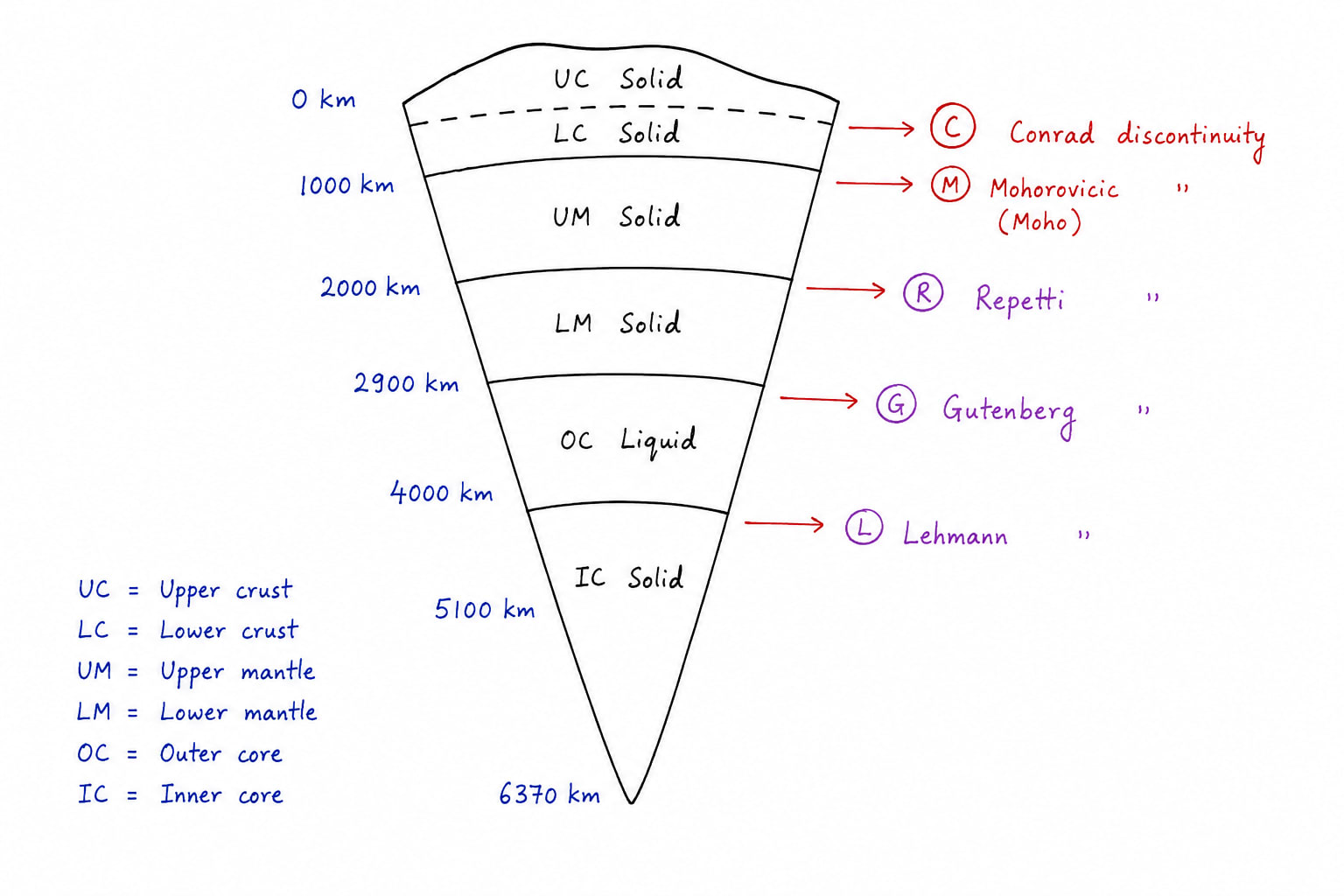
The study of P and S waves suggest that the Earth's interior is not a homogeneous medium it is heterogeneous. It is divided primarily into three layers, i.e., crust, mantle, and core.
-
Crust Further study suggest that the crust also has two layers, upper crust and lower crust. Upper crust is further divided into two parts
- Oceanic Crust:- It has thickness of 0-10km. It is primarily made up of basalt.
- Continental Crust:- Continental crust has thickness of 35-40km. It is primarily made up of granite. upper crust is separated from the lower crust by Conrad discontinuity.
-
Mantle
Mantle has two parts
4. Upper Mantle:- Upper mantle is separated from lower crust by Mohorovičić discontinuity. It is also called asthenosphere.
5. Lower Mantle:- Lower mantle is separated from upper mantle by Repetti discontinuity. It extends up to depth of 2900 km.
- Core
Core is divided into two parts
7. Outer core:- It is in liquid state. It extends from 2900km to 5150km. This layer is responsible for the electromagnetic shield of the earth. It is separated from lower mantle by Gutenberg discontinuity.
8. Inner Core:- Inner core is in solid state. It extends between 5150km to 6370km.
Geomagnetism
Geomagnetism refers to Earth's magnetic field, which makes the earth behave like a giant bar magnet with magnetic north and south poles. The magnetic axis is inclined by about 11° to the Earth's rotation axis. This magnetic field extends into space forming the magnetosphere which surrounds and protects earth.
Causes of Geomagnetism
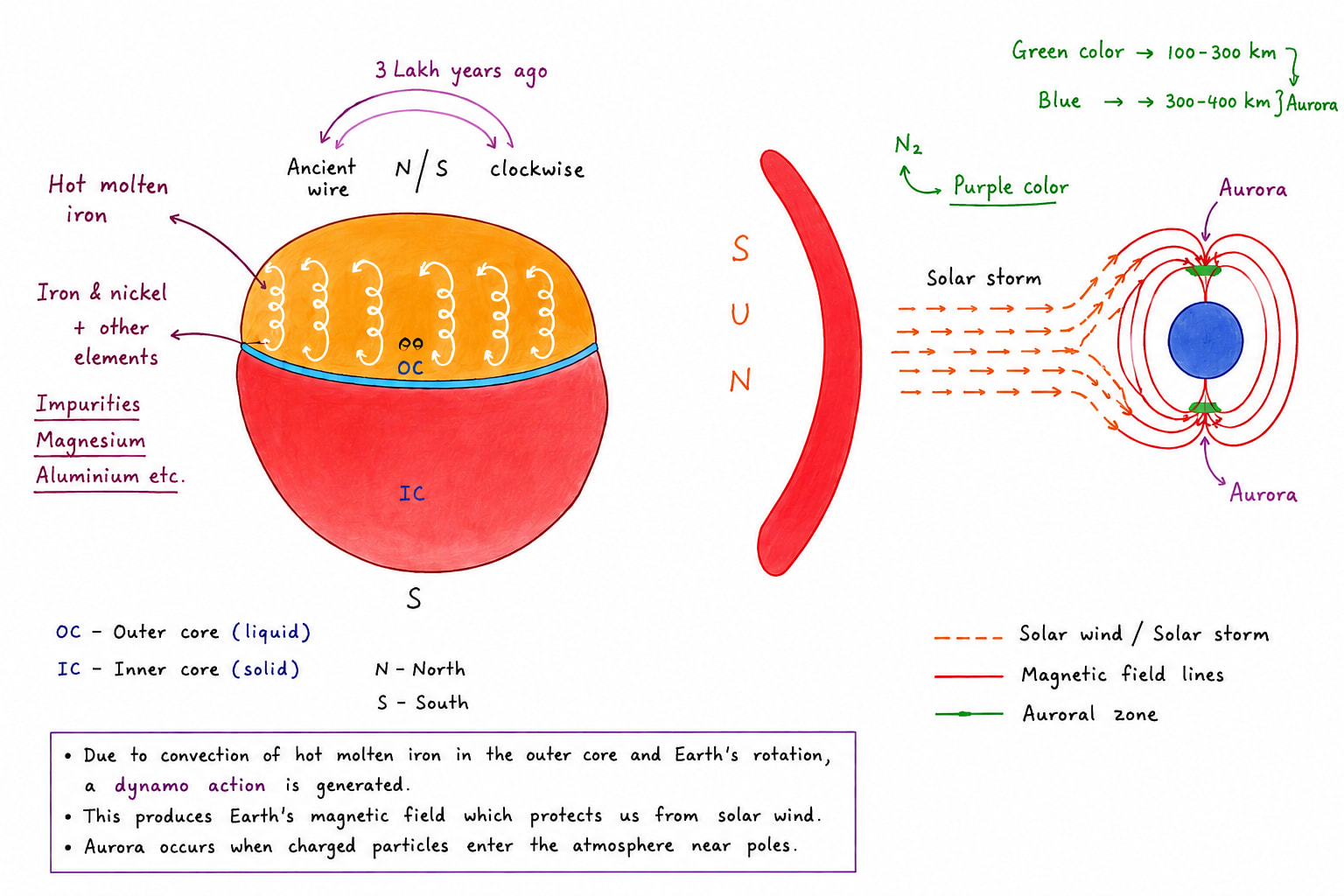
the Earth's magnetic field is generated by geodynamic mechanism operating in the liquid outer core
-
The outer core consists mainly of molten iron and nickel.
-
Convection currents caused by heat escaping from the core lead to the movement of these electrically conductive fluids.
-
Combined with the Earth's rotation, Coriolis force, These motions generate electric currents.
-
The electric current in turn produces Earth's magnetic field.
Impact of Geomagnetism
-
Protection from solar radiation.
-
Deflects charged particles from the Sun, preventing harmful radiation from reaching the Earth's surface.
-
Formation of Auroras:- Interaction between solar winds and magnetic field produces auroras near polar regions.
-
Geomagnetic Storms:- Strong solar activity can disturb the magnetic field affecting satellite, ISS, communication system, GPS and power grids.
-
Magnetic navigation:- Compasses aligned with Earth's magnetic field and aid navigation.
Importance of Geomagnetism
-
Essential for the existence and evolution of life by shielding earth from solar and cosmic radiation.
-
helps ships navigate, aircraft, migratory birds like Amur Falcon which flies from Mongolia, Southern Siberia, Northern China to South Africa, Zimbabwe, Namibia and Botswana via India, Nagaland where it rests for a few weeks or months. Similarly, Siberian birds coming from Siberia to Bharatpur of Rajasthan.
-
It provides clues about the Earth's interior and core dynamics.
-
It supports space weather forecasting and satellite operations.
Recent Development
-
Scientists continue to monitor the weakening and shifting of the magnetic field particularly the South Atlantic anomaly where magnetic intensity is usually low.
-
European Space Agency's Swarm satellites to study changes in Earth's magnetic field to improve understanding of the Earth's interior core process and space weather.
Conclusion
Geomagnetism is dynamic phenomenon generated by the Earth's liquid outer core beyond enabling navigation, it acts as a protective shield against harmful solar radiation and provide critical insights into the Earth's interior.
Auroras
Auroras are spectacular natural light displays that occur in the upper atmosphere, ionosphere near the polar regions. These are known as the aurora borealis In the Northern Hemisphere. They are also called the northern lights. In the Southern Hemisphere these are called aurora australis or southern lights.
Causes of Auroras
Auroras result from the interaction between the solar winds and Earth's magnetic field
-
the Sun continuously emits charged particles called the solar winds.
-
the Earth's magnetosphere channels these particles towards the polar regions.
-
The particles collide with gases in the uppermost atmosphere mainly between the altitude of 80-400km i.e. ionosphere.
-
There is presence of oxygen and nitrogen gases which become excited due to this interaction and release energy in the form of visible light.
Colours of Auroras
-
Green Colour:- It is mainly due to the presence of oxygen between 100-300km. It is most common colour.
-
Red Colour:- It is because of oxygen between 300-400km.
-
Blue and Purple Colour:- It is because of Nitrogen.
Importance of Auroras
-
Indicator of space weather:- Auroras help scientists to monitor solar activity and geomagnetic storm.
-
Evidence of earth-sun interaction:- Demonstrate the functioning of the Earth's magnetic field and magnetosphere.
-
Scientific Significance:- Provide insights into atmospheric physics, plasma dynamics and solar terrestrial relation.
-
Importance for technology:- Auroral events often accompany geomagnetic storms that can affect satellites, ISS, GPS, radio communication, power transmission, etc.
-
Economic and tourism value:- Auroras attract millions of tourists to the countries of north like Canada, Norway, Iceland, Finland to watch northern lights specially in the months of November to February. In the southern hemisphere, tourists visit Chile, Argentina, New Zealand, etc. in the months of May to August.
Conclusion
Auroras are a visible manifestation of interaction between sun and earth. Beyond their scenic beauty they provide valuable information about space weather, geomagnetism and other atmospheric processes, making them important for both scientific and technological preparedness.